
Adaptive Space:
Why Some Adaptive Systems Discover More Than Others
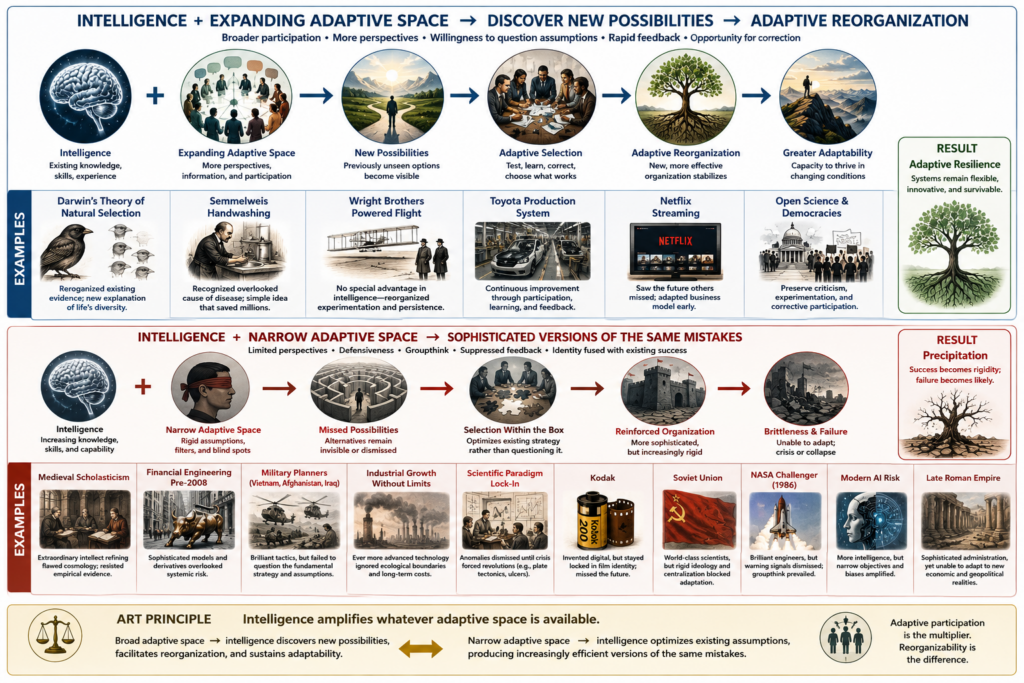
Why do some people consistently discover possibilities that others never see? Why do some organizations innovate while others become trapped by their own success? Why do certain scientific revolutions transform entire disciplines while equally intelligent researchers remain committed to older paradigms? The usual explanation is intelligence. Smarter people solve more difficult problems.
Intelligence certainly matters. But it does not explain everything. History repeatedly shows that individuals, organizations, and civilizations with no obvious advantage in intelligence often discover possibilities that remain invisible to others. Charles Darwin did not possess greater raw intelligence than many of his contemporaries, yet he reorganized biological evidence into the theory of natural selection. Ignaz Semmelweis recognized the importance of handwashing while many equally intelligent physicians rejected his conclusions. The Wright brothers, neither university-trained engineers nor representatives of major research institutions, achieved powered flight while better-funded competitors failed. Toyota transformed automobile manufacturing through continuous improvement rather than overwhelming technological superiority. Netflix recognized the implications of internet streaming while Blockbuster remained committed to an increasingly obsolete business model.
Open scientific communities frequently outperform isolated experts because they preserve corrective participation, and democratic societies have often proven more adaptable than rigid authoritarian systems because they permit criticism and experimentation. In each case, the decisive factor was not greater intelligence alone but the capacity to reorganize assumptions before reality made previous successes untenable.
For ART, there are even stronger examples because they illustrate adaptive reorganization despite inferior resources:
- Mammals surviving the K–Pg extinction while the dominant dinosaurs disappeared.
- The early Christian movement expanding within the Roman Empire despite overwhelming political weakness.
- The Dutch Republic becoming a commercial and scientific leader despite its small size.
- Meiji Japan reorganizing its institutions rapidly while Qing China struggled to adapt.
- Linux outperforming many proprietary operating systems through distributed participation.
- Wikipedia surpassing expert-produced encyclopedias in breadth and continual updating.
- The Allied codebreakers at Bletchley Park, whose interdisciplinary organization often proved more important than the brilliance of any single individual.
From an ART perspective, these examples share the same underlying principle. They did not win because they possessed the greatest intelligence, wealth, population, or military strength. They won because they preserved greater reorganizability. They admitted new information, experimented with alternatives, corrected errors more rapidly, and allowed successful organization to be reorganized before changing conditions rendered it obsolete. Adaptive Reorganization Theory (ART) proposes that the difference frequently lies not in intelligence itself but in the size of adaptive space.
What Is Adaptive Space?
Adaptive space is the range of possibilities available to an adaptive system. Some adaptive systems operate within very narrow spaces. They repeatedly generate variations of solutions they already know. Others operate within much larger spaces. They are able to perceive relationships, opportunities, and solutions that previously seemed unimaginable. Adaptive space is therefore not simply the amount of information available. It is the number of adaptive possibilities that can realistically be explored. Larger adaptive space means more opportunities for successful adaptation.
More Than Perspective
Many contemporary theories emphasize the importance of perspective-taking. Perspective certainly matters. Seeing through another person’s eyes often reveals possibilities hidden by our own assumptions. ART fully agrees. However, perspective is only one dimension of adaptive space. Adaptive systems also expand through:
- longer time horizons
- multiple organizational levels
- broader spatial scales
- developmental diversity
- biological diversity
- symbolic systems
- artificial intelligence
Each enlarges the space within which adaptive selection can occur. Adaptive space is therefore multidimensional.
Adaptive Participation Expands Adaptive Space
Adaptive space does not expand automatically; it grows through participation. Every new participant potentially contributes information unavailable to existing participants. A child notices different patterns than an adult. A customer sees different problems than management. An ecologist notices relationships invisible to an economist. Artificial intelligence may discover patterns beyond unaided human cognition. Dreams often reveal possibilities waking consciousness overlooks. Participation enlarges adaptive possibility. The question is not simply “How many participants?” The question is, “How many genuinely different forms of participation?”
Intelligence Is Not Enough
Imagine two equally intelligent organizations. One encourages disagreement, experimentation, outside feedback, and long-term thinking. The other rewards conformity, protects established procedures, and discourages criticism. Both possess equally intelligent people, yet one operates within a far larger adaptive space. The difference is not intelligence; it is participation.
History repeatedly demonstrates that increasing intelligence without expanding adaptive space often produces increasingly sophisticated versions of the same mistakes. Medieval theologians constructed extraordinarily subtle arguments while remaining committed to cosmological assumptions that empirical observation would later overturn. More powerful financial models contributed to increasingly complex derivatives before the 2008 financial crisis without recognizing systemic fragility. Military planners have repeatedly refined tactics for winning wars while failing to question whether the wars themselves were strategically or politically sustainable, as seen in Vietnam, Afghanistan, Iraq, Ukraine, and Iran. Industrial societies have developed ever more sophisticated technologies for extracting and consuming resources while often neglecting the ecological limits upon which those systems ultimately depend. Scientific communities have at times become increasingly technically proficient within established paradigms while dismissing anomalies that later precipitated major revolutions, as occurred before the acceptance of plate tectonics, continental drift, and the bacterial causes of ulcers. In each case, intelligence increased, but the space within which intelligence operated remained constrained by prevailing assumptions. The result was not adaptive reorganization but increasingly efficient reinforcement of an increasingly maladaptive organization. There are many additional examples:
Cold War nuclear strategy. Enormous intellectual effort produced increasingly sophisticated deterrence theories while remaining inside the assumption that security depended upon ever-larger nuclear arsenals. Intelligence optimized the strategy without escaping its underlying dilemma.
The Soviet Union. It produced world-class scientists, mathematicians, engineers, and military strategists, yet its centralized political structure severely limited corrective participation. Technical brilliance could not compensate for organizational rigidity.
Kodak. Kodak employed highly intelligent scientists—indeed, it invented one of the first digital cameras—but organizational identity remained tied to photographic film. Intelligence improved the existing business while adaptive space narrowed.
NASA before the Challenger disaster. The organization contained extraordinary engineering talent, yet normalization of deviance gradually narrowed the range of acceptable concerns until warning signals were systematically discounted.
The late Roman Empire. Administrative sophistication, legal refinement, and military organization continued to improve in many respects, but increasing bureaucratic rigidity reduced the empire’s ability to adapt to changing economic and geopolitical realities.
Modern AI systems. Increasing model size and computational power can produce more capable reasoning within existing objectives, but without mechanisms for expanding participation, revising goals, or incorporating corrective feedback, greater intelligence can simply amplify existing biases or optimize flawed objectives.
From ART’s perspective, these examples illustrate a general principle: intelligence amplifies whatever adaptive space is available. If adaptive space is broad, intelligence discovers new possibilities, questions assumptions, and facilitates reorganization. If adaptive space is narrow, intelligence primarily optimizes existing assumptions, making systems more efficient at pursuing strategies that may already be becoming maladaptive. Thus the fundamental limitation is not insufficient intelligence but insufficient reorganizability.
The Dimensions of Adaptive Space
ART proposes that adaptive space can expand along many dimensions simultaneously. Perspective is one and time is another. Individuals operating only within immediate concerns often make different decisions than those considering decades or generations. Scale is another. Problems that appear unsolvable at one level sometimes become straightforward when viewed from larger or smaller organizational scales. Development adds another dimension. Individuals and cultures organize experience differently depending upon developmental capacities. Species contribute still another. Humans increasingly learn from other organisms, ecological systems, and evolutionary processes. Artificial intelligence introduces an entirely new dimension by participating alongside rather than replacing human cognition. Adaptive space expands whenever adaptive participation expands.
Why Adaptive Space Matters
Larger adaptive space does not guarantee better decisions, but it does guarantee more possibilities available for selection. Selection remains essential. Reality ultimately determines which possibilities actually succeed. Adaptive space therefore precedes adaptive selection. Without expanded adaptive space, adaptive systems repeatedly choose among increasingly limited alternatives.
Civilization’s Greatest Challenge
Human civilization has dramatically expanded adaptive space through language, writing, science, markets, education, communication, and technology. Artificial intelligence may represent the largest expansion yet, yet every expansion also creates new forms of stabilization. Scientific disciplines become specialized and institutions become bureaucratic. Cultures develop unquestioned assumptions and technologies become infrastructures that are difficult to change. Adaptive space expands, then it gradually contracts as successful organization stabilizes. The challenge is not merely creating adaptive space; it is continually preserving it.
Adaptive Space and the Adaptive Cycle
Adaptive space occupies a central place within the Adaptive Cycle. Generative sublimation creates new possibilities and adaptive participation expands adaptive space. Adaptive selection evaluates those possibilities and adaptive stability preserves successful adaptations. Without adaptive space, the cycle collapses into repetition. Without stability, adaptive space never produces lasting achievement. Healthy adaptive systems require both.
A Testable Hypothesis
ART proposes a simple prediction: Adaptive systems operating within larger adaptive spaces should consistently outperform equally intelligent systems operating within smaller adaptive spaces over sufficiently long periods of time. This prediction applies to:
- individuals
- families
- organizations
- scientific communities
- governments
- civilizations
- artificial intelligence
If supported, adaptive space may prove to be one of the most important variables underlying long-term adaptation.
Looking Forward
Adaptive space is not a destination; it continually expands and contracts. Healthy adaptive systems deliberately preserve opportunities for new participation before existing success narrows future possibilities. The question therefore becomes not simply, “How intelligent are we?” But rather, “How much adaptive space have we preserved for discovering what we do not yet know?” Adaptive Reorganization Theory suggests that this question may be one of the defining challenges facing individuals, organizations, and civilizations in the twenty-first century.
For more information regarding ART, see AdaptiveReorganizationTheory.Com.