Adaptive Reorganization Theory
A New Theory of Adaptation
Adaptive Reorganization Theory (ART) proposes that the greatest threat to adaptive systems is not failure, but success that becomes increasingly resistant to revision.
Whether we examine organisms, individuals, organizations, civilizations, or artificial intelligence, the same paradox appears repeatedly:
The very processes that create success eventually undermine the capacity to continue adapting.
ART proposes a general explanation for this pattern and a practical framework for preserving adaptive reorganizability.
The Central Question
How do adaptive systems remain capable of reorganizing themselves without sacrificing the achievements they have already gained?
This question connects psychology, biology, evolution, organizational learning, systems science, complexity theory, and civilization.
The Adaptive Puzzle
Why do successful people, successful organizations, successful sciences, successful governments, and successful civilizations repeatedly lose the very adaptive capacities that made them successful?
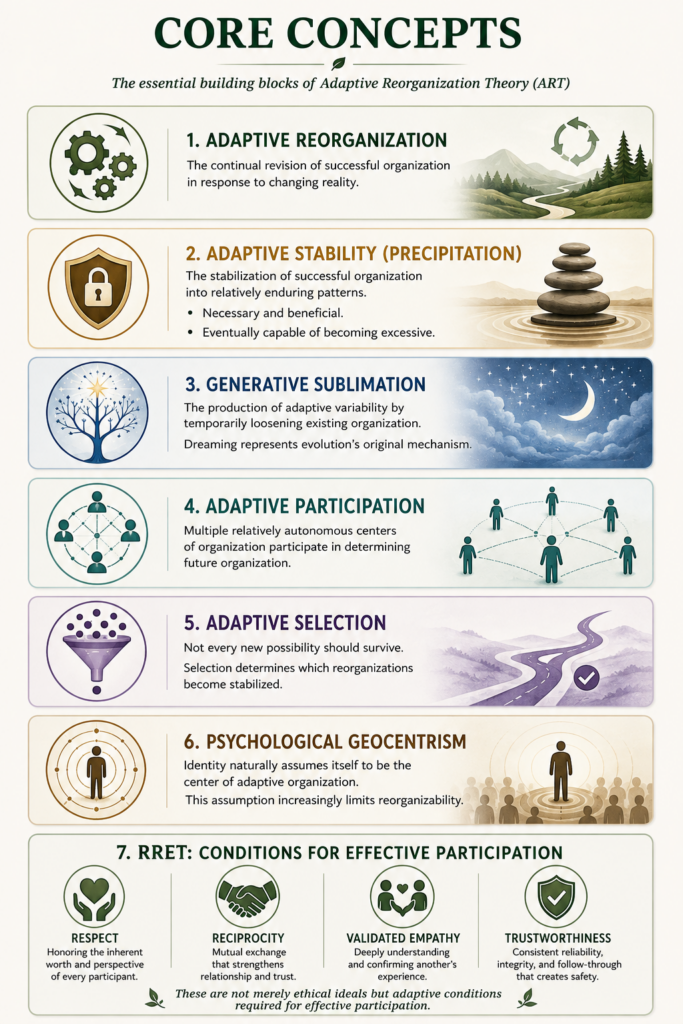
Adaptive Reorganization Theory proposes that every adaptive success creates stabilization, and every stabilization gradually becomes resistant to adaptive reorganization unless complementary processes continually reopen it to correction.
Overview
Adaptive Reorganization Theory (ART)
Adaptive Reorganization Theory is a general theory of adaptation. It proposes that adaptive systems—from organisms and individuals to organizations, civilizations, and artificial intelligence—remain successful only so long as they preserve their capacity for continual adaptive reorganization.
The central paradox ART seeks to explain is simple:
Why do successful adaptive systems so often lose the very capacities that made them successful?
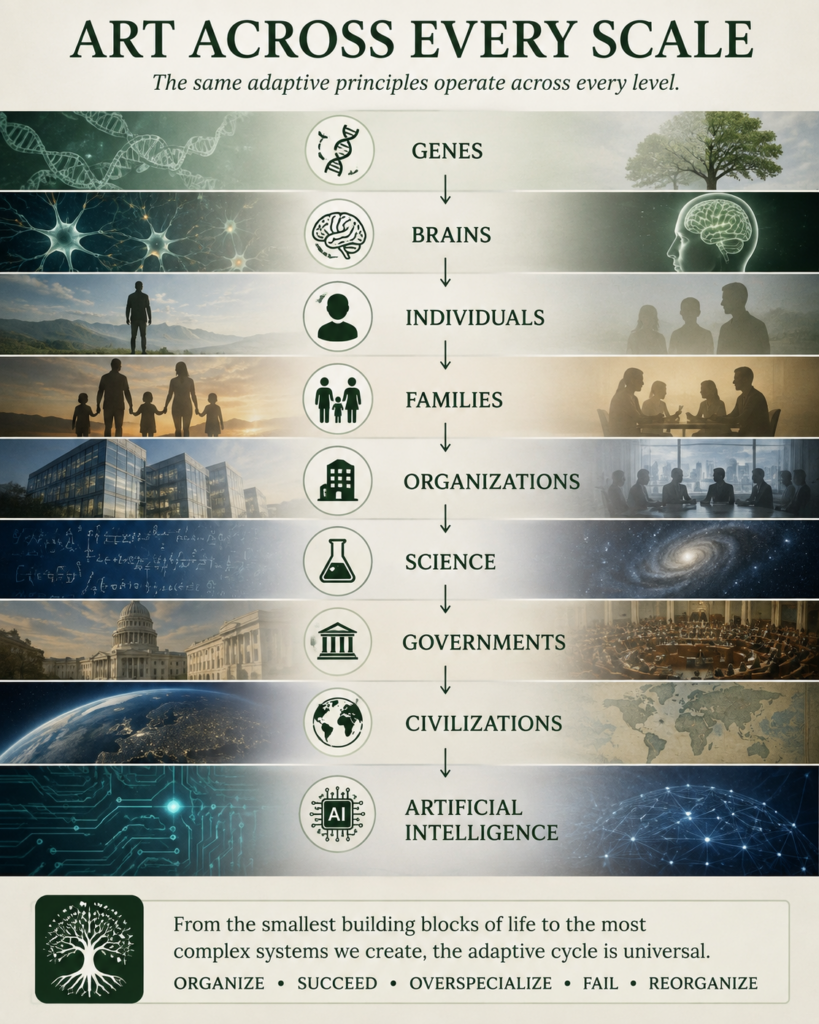
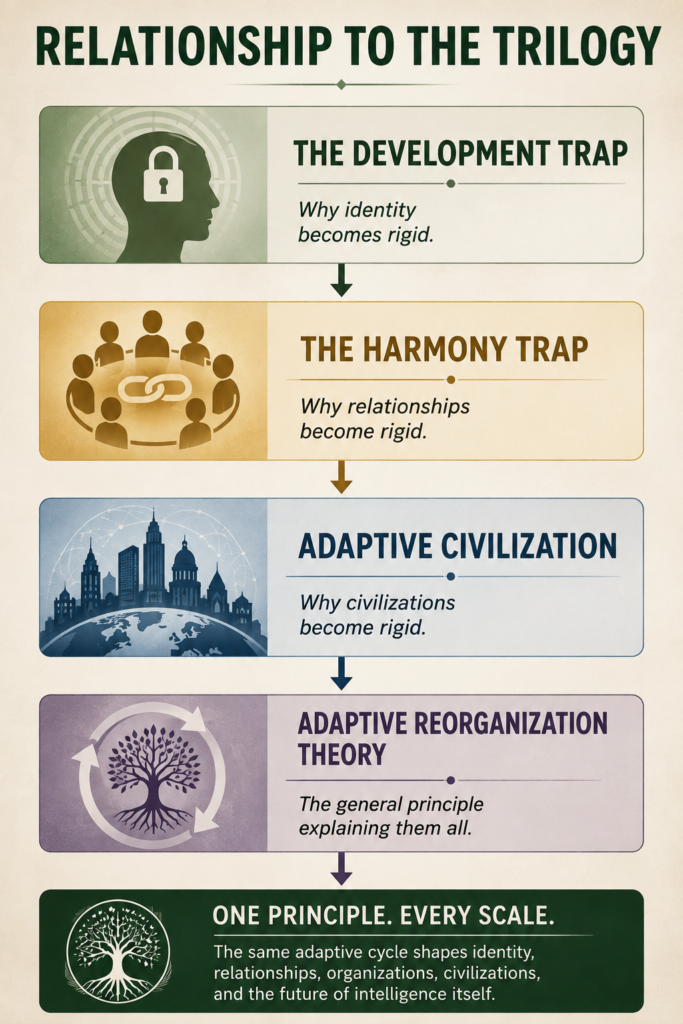
Rather than treating psychology, organizations, biology, and civilization as separate domains, ART argues that they are different expressions of the same adaptive principles operating at different scales.
The Adaptive Cycle
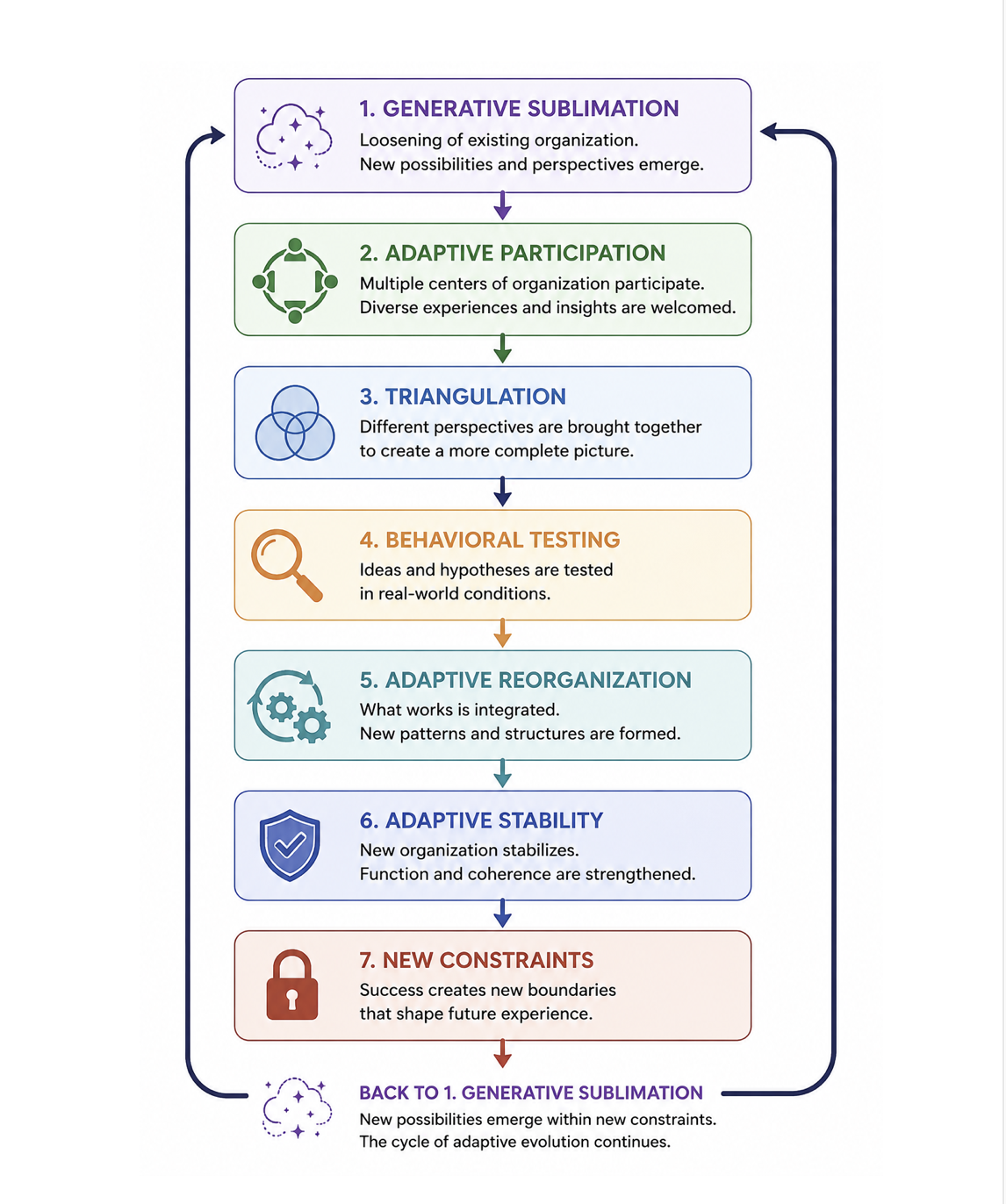
Every adaptive system continually cycles through these five processes.
Problems emerge when precipitation accumulates faster than adaptive sublimation can reorganize it.
Five Core Principles
1. Success Creates Stability
Adaptive success becomes stabilized into identity, habits, institutions, and traditions.
2. Stability Creates Rigidity
Every successful organization gradually resists revision.
3. Adaptation Requires Reorganization
New circumstances require existing organization to reopen itself to correction.
4. Participation Determines Adaptation
Adaptive systems improve when multiple relatively autonomous centers of organization participate in selecting future organization.
5. Civilization Has Changed the Adaptive Problem
Modern civilization generates symbolic organization much faster than evolution originally evolved to reorganize it.
Predictions
ART is scientific because it makes predictions. Examples:
ART predicts that:
-
Success creates increasing resistance to revision.
-
Larger adaptive systems require broader adaptive participation.
-
Intelligence alone cannot preserve adaptation.
-
Organizations preserving reorganizability outperform equally intelligent but more rigid organizations.
-
Civilizations fail when adaptive precipitation exceeds adaptive sublimation.
-
AI functioning as participant will outperform AI functioning as authority.
-
Practices increasing adaptive sublimation should improve long-term adaptive reorganizability.
Relationship to Integral Deep Listening
Adaptive Reorganization Theory explains why adaptive systems stop adapting.
Integral Deep Listening (IDL) proposes one practical methodology for deliberately strengthening adaptive sublimation, adaptive participation, and adaptive reorganization.
ART is the theory.
IDL is one proposed application.
Why This Matters
- Why successful companies lose adaptability.
- Why civilizations collapse despite increasing complexity.
- Why intelligent people become psychologically rigid.
- Why AI systems eventually require reorganizability rather than greater intelligence.
Successful adaptation eventually undermines future adaptability unless systems preserve their capacity for reorganization.
FAQ
Is ART another developmental theory?
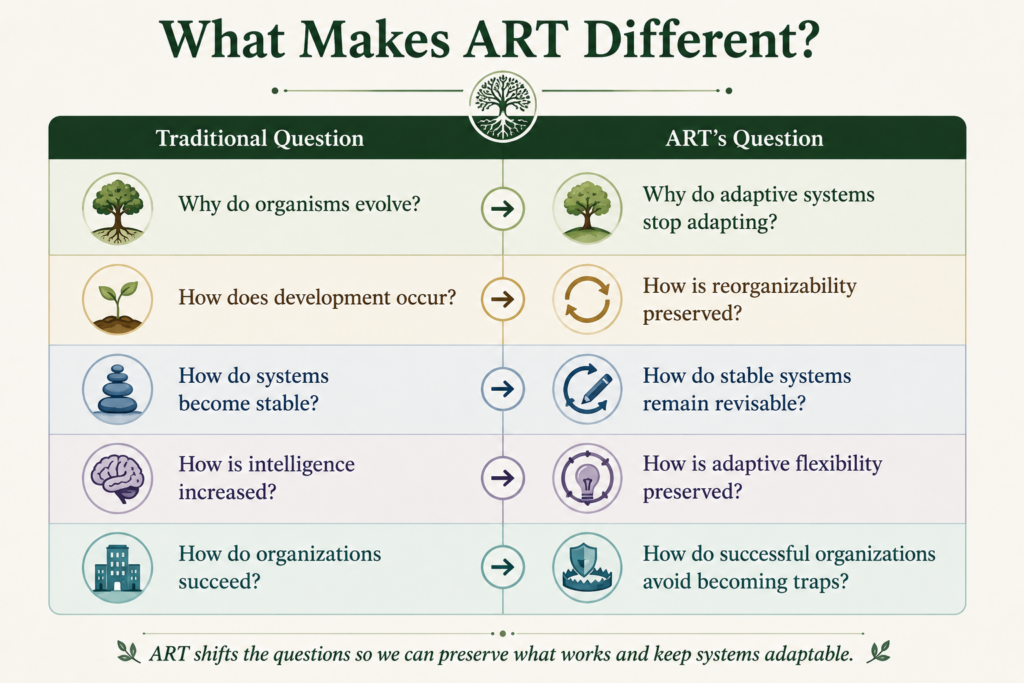
No. Developmental theories explain how adaptive organization grows, becomes more complex, or progresses through identifiable stages. ART asks a different question: once adaptive systems have become successful, how do they preserve their capacity to reorganize in response to changing conditions?
Development remains essential. ART does not replace developmental theory—it complements it by explaining why successful development can eventually become increasingly resistant to revision. The central challenge is not growth, but preserving reorganizability after success.
Is ART only about psychology?
No. ART is a general theory of adaptation, not a theory of psychology. It proposes that the same adaptive principles operate across every scale—from organisms and individuals to families, organizations, scientific communities, governments, civilizations, and artificial intelligence.
Psychology is simply one important application. ART seeks to identify the common principles that explain how adaptive systems become successful, why successful systems gradually lose reorganizability, and how that capacity can be preserved regardless of the system being studied.
Does ART replace evolution?
No. ART does not replace evolutionary theory. Evolution explains how adaptive systems change over long periods through processes such as variation, selection, and inheritance. ART seeks to identify one general adaptive principle operating within those processes—and within many adaptive systems that are not biological.
Rather than asking how organisms evolve, ART asks why successful adaptive systems eventually become resistant to further adaptation and how they preserve the capacity to reorganize in response to changing reality. In this sense, ART complements evolutionary theory by focusing on the maintenance of adaptive flexibility across biology, psychology, organizations, civilizations, and artificial intelligence.
Is ART anti-development?
No. ART views development as indispensable. Increasing complexity, learning, specialization, and the accumulation of successful adaptations are essential for the survival and flourishing of every adaptive system. Without development, there would be no science, civilization, expertise, or technological progress.
The challenge arises after success. Every successful adaptation tends to stabilize into enduring patterns that become increasingly resistant to revision. ART argues that the problem is not development itself but the excessive stabilization of successful development. Adaptive systems remain healthy only when they preserve the capacity to reorganize in response to changing conditions.
Rather than opposing development, ART explains why development alone is not enough. Long-term adaptability depends on balancing the stability created by successful development with continual opportunities for adaptive reorganization.
Is dreaming enough?
Dreaming remains one of evolution’s greatest adaptive innovations. By relaxing waking constraints, generating novel associations, and exploring alternative organizations of memory, emotion, identity, and prediction, dreaming has helped adaptive systems remain flexible throughout evolutionary history.
ART asks a different question: has human civilization created forms of adaptive stabilization and precipitation that now exceed what dreaming alone can continually reorganize? Language, writing, institutions, governments, markets, science, technology, and artificial intelligence all accumulate increasingly stable forms of organization that may persist across generations.
ART proposes that dreaming remains indispensable but may no longer be sufficient by itself. Modern adaptive systems may require additional methods of deliberately reopening successful organization to corrective participation. Integral Deep Listening (IDL) is proposed as one possible methodology for accomplishing this.
What role does Integral Deep Listening (IDL) play?
Integral Deep Listening (IDL) is one practical methodology for applying the principles of Adaptive Reorganization Theory. Whereas ART explains why adaptive systems become increasingly resistant to reorganization and identifies the conditions required for preserving adaptability, IDL provides one structured process for deliberately strengthening adaptive sublimation, adaptive participation, adaptive selection, and adaptive reorganization.
IDL is based on interviewing relatively autonomous perspectives while suspending premature interpretation and testing the resulting insights through behavior. Its purpose is not simply self-understanding, but increasing the capacity of individuals and groups to remain reorganizable in response to changing reality.
ART is the general theory. IDL is one proposed application of that theory. ART neither depends upon IDL nor claims that IDL is the only effective method for cultivating adaptive reorganizability. Rather, IDL provides one practical example of how ART’s principles can be deliberately implemented and empirically tested.