Applications
Adaptive Reorganization Theory is not confined to one discipline.
If ART describes a general principle of adaptation, it should apply wherever adaptive systems exist. The applications below explore how the same adaptive dynamics appear at different scales—from individuals to civilizations and artificial intelligence.
Psychology
🧠
Why do successful people become psychologically rigid?
Explore psychological geocentrism, adaptive participation, dreaming, adaptive sublimation, identity, and long-term adaptability.
Psychotherapy & Coaching
🤝
How can therapists and coaches strengthen adaptive reorganizability rather than merely reduce symptoms?
Applications include:
- Integral Deep Listening
- dreamwork
- trauma
- resilience
- emotional regulation
- identity development
Parenting & Education
👨👩👧
How do children learn adaptability?
ART suggests that curiosity, play, perspective-taking, and corrective participation may be more important than simply accumulating information.
Organizations & Leadership
🏢
Why do successful organizations become bureaucratic?
How can leadership preserve innovation without sacrificing stability?
Topics include:
- competency traps
- adaptive participation
- organizational learning
- leadership
- institutional resilience
Science
🔬
Scientific knowledge advances through continual correction.
How do successful paradigms gradually become resistant to revision?
ART explores science itself as an adaptive system.
→ Science
Government & Public Policy
🏛
Governments require stability.
Societies require reorganizability.
ART examines the adaptive conditions necessary for long-term resilience without advocating any particular political ideology.
Civilization
🌍
History repeatedly demonstrates that civilizations become increasingly vulnerable when preserving existing organization becomes more important than responding to changing reality.
ART asks how civilizations remain capable of adaptive reorganization before crisis forces change.
Artificial Intelligence
🤖
AI increases intelligence.
Does it also increase reorganizability?
ART explores how adaptive participation, corrective feedback, and adaptive selection may become more important than optimization alone.
Dream Research
🌙
Dreaming may represent evolution’s original mechanism for generating adaptive variability.
ART extends that question:
Can civilization now generate adaptive precipitation faster than dreaming alone can continually reorganize?
Conflict Resolution
⚖️
Why do successful relationships become increasingly resistant to corrective participation?
ART applies to:
- couples
- families
- organizations
- diplomacy
- international conflict
Ethics & RRET
❤️
Respect.
Reciprocity.
Validated Empathy.
Trustworthiness.
ART proposes that these are not merely moral ideals but adaptive conditions required for effective participation.
→ RRET
Research
📊
ART makes predictions.
Many are testable.
Explore current hypotheses, proposed measures, and ongoing research.
→ Research
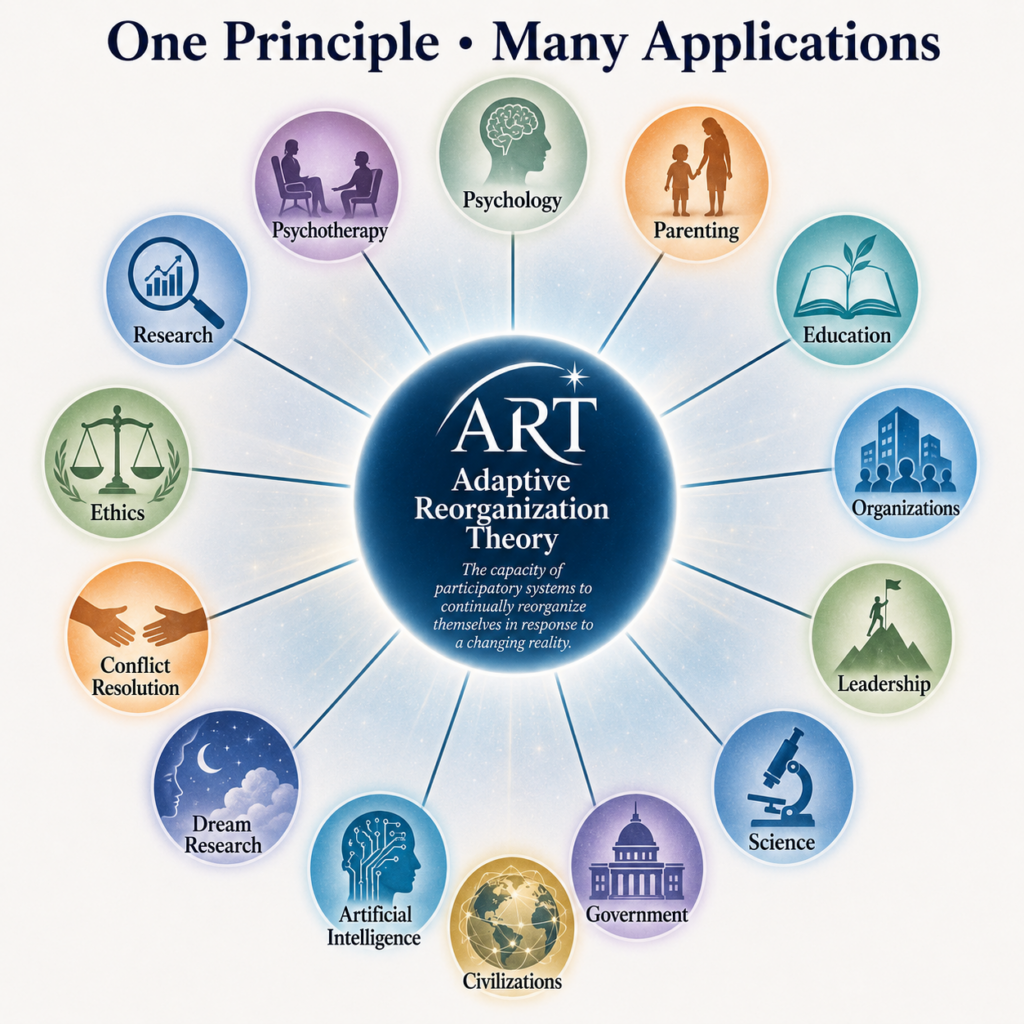
ART is not another specialty. It is an attempt to identify the adaptive principles shared by every specialty.
Don’t Believe ART. Test It.