Start Here
New to Adaptive Reorganization Theory? This page introduces the central question, explains why it matters, and shows you where to begin.
Why do successful adaptive systems eventually stop adapting?
Adaptive Reorganization Theory (ART) proposes that this question has a common answer across psychology, organizations, science, governments, civilizations, and artificial intelligence. Success creates stability. Stability gradually becomes resistant to reorganization unless adaptive systems continually reopen themselves to corrective participation.
Three Questions
What is ART?
A fifteen-minute introduction to the theory.
Why does it matter?
Discover how ART applies to psychology, organizations, civilization, and AI.
Where should I begin?
Follow the recommended path based on your interests.
Where do I fit?
Choose Your Path
I’m new to ART.
Welcome. Adaptive Reorganization Theory begins with one deceptively simple question: Why do successful adaptive systems eventually lose the very capacities that made them successful? ART proposes that the answer applies across psychology, biology, organizations, civilizations, and artificial intelligence.
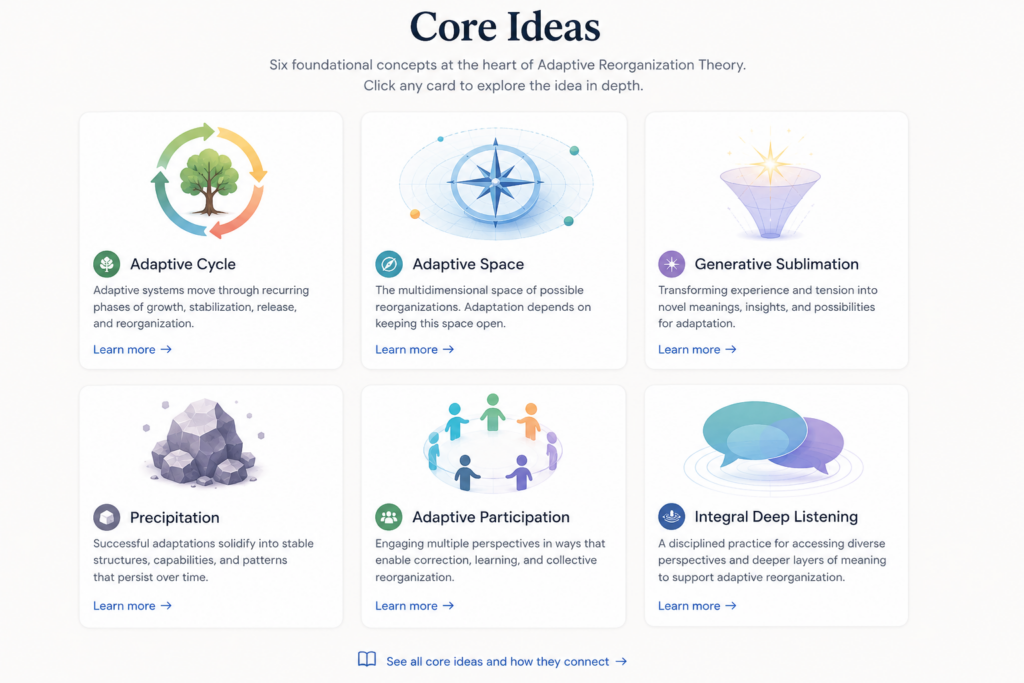
Begin with What is ART?, then explore the Adaptive Cycle, the Five Core Principles, and the Core Concepts. These provide the foundation for everything else on the site.
I’m a therapist or coach.
ART explains why people often become psychologically rigid despite successful development, healing, or achievement. It focuses on preserving the capacity for continual adaptive reorganization rather than simply reducing symptoms or promoting growth.
Explore the sections on Integral Deep Listening (IDL), Generative Sublimation, Adaptive Participation, and RRET to see how these principles can be applied in clinical practice, coaching, and personal development.
I’m interested in dream research.
ART proposes that dreaming is evolution’s original mechanism for generating adaptive variability, allowing existing organization to loosen and reorganize before becoming excessively rigid. It then asks whether modern civilization has created adaptive challenges that dreaming alone can no longer fully address.
Begin with the sections on Generative Sublimation, Dreaming, and Integral Deep Listening to explore the relationship between dreams, adaptive flexibility, and psychological reorganization.
I’m interested in organizations and leadership.
Organizations succeed by creating stability, but that same stability can gradually become resistant to innovation, feedback, and change. ART explains why competency traps, bureaucratic rigidity, and institutional decline emerge—and how reorganizability can be deliberately preserved.
Explore Adaptive Participation, Adaptive Selection, and the applications of ART to leadership, organizational learning, and long-term adaptive resilience.
I’m interested in civilization and AI.
ART argues that the same adaptive principles governing individuals also operate within governments, scientific communities, civilizations, and artificial intelligence. Modern civilization has transformed the adaptive problem by generating stable symbolic organization far faster than evolution originally evolved to reorganize it.
Explore ART Across Every Scale, Adaptive Civilization, and the AI sections to see how adaptive reorganizability can be understood from genes to global societies.
I want to read the books.
The trilogy develops ART from three complementary perspectives. The Development Trap examines why identities become rigid. The Harmony Trap explores rigidity in relationships and organizations. The Adaptive Civilization extends these principles to societies and the future of intelligent systems. Together they lead naturally to Adaptive Reorganization Theory as the general principle that unifies them.
Visit the Books section to explore the trilogy, recommended reading order, summaries, and related essays.
What You’ll learn
After exploring ART, you’ll understand:
- Why success often precedes adaptive failure.
- Why adaptive systems naturally become resistant to correction.
- How reorganizability can be deliberately preserved.
- Why intelligence alone cannot sustain adaptation.
- How the same adaptive principles operate from individuals to civilizations.
- Why ART places participation—not simply development—at the center of adaptation.
Ready to Explore?
Whether your interest is psychology, organizations, civilization, dream research, or artificial intelligence, the goal of this site is the same:
To understand how adaptive systems preserve the capacity to continually reorganize themselves before crisis forces change.
Choose where you’d like to go next.
❓ FAQ
Adaptive Reorganization Theory is not primarily about explaining why adaptive systems succeed. It is about understanding how successful adaptive systems remain capable of adapting.