The Trilogy
Adaptive Reorganization Theory did not emerge all at once. It developed gradually through an investigation of the etiology of dreaming and realizing it was deeply embedded in evolutionary processes that enhance adaptability and reduce rigidity. It then became clear that adaptive rigidity existed at progressively larger scales.
The first question concerned the individual: Why do successful identities become increasingly resistant to change?
The second expanded to relationships and organizations: Why do successful systems lose their capacity for corrective participation?
The third extends the same inquiry to civilizations and artificial intelligence: How can societies preserve the capacity for adaptive reorganization before crisis forces change?
Each book investigates one level of this larger adaptive puzzle. Together they culminate in Adaptive Reorganization Theory (ART)—a general framework proposing that the same adaptive principles operate across biology, psychology, organizations, civilizations, and intelligent systems.
Whether read individually or as a trilogy, these books trace the development of a single question:
How do successful adaptive systems remain capable of continual reorganization?
How The Trilogy Came to Be Written
Explore the Trilogy
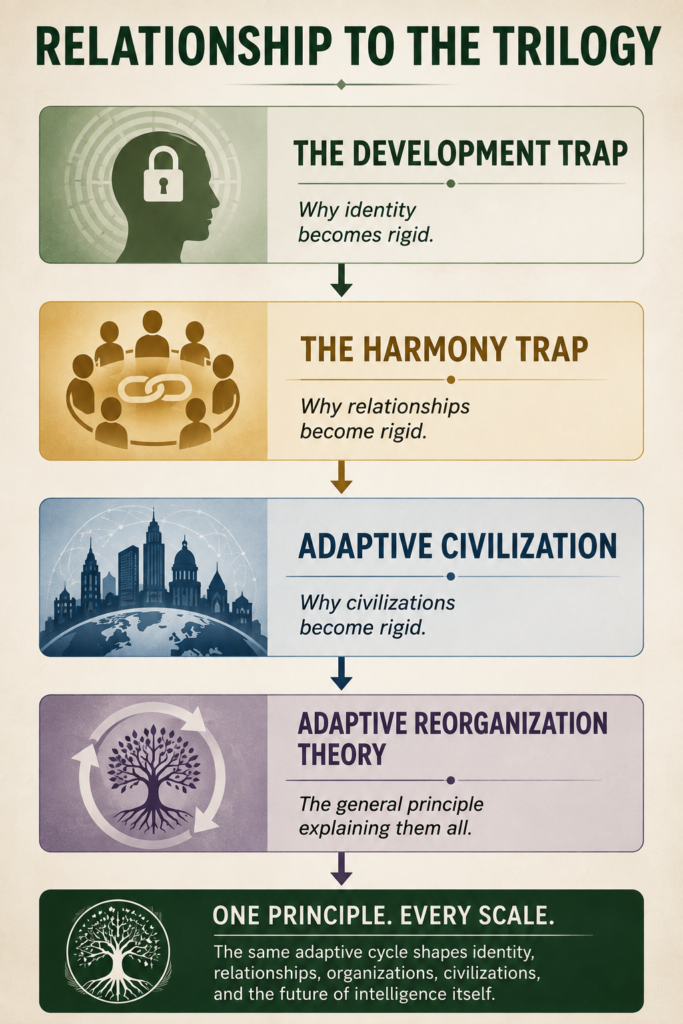
Each volume approaches adaptive reorganizability from a different perspective while building toward a unified theoretical framework.
The Development Trap
Why individuals become rigid.
↓
The Harmony Trap
Why relationships and organizations become rigid.
↓
The Adaptive Civilization
Why civilizations become rigid.
↓
Adaptive Reorganization Theory
The general principle unifying them all.
The Development Trap
Why Success Can Become the Greatest Obstacle to Further Growth
Development is one of humanity’s greatest achievements. It allows individuals, organizations, and societies to become more capable, more complex, and more effective. Yet development also contains a paradox. The very structures that enable success gradually become resistant to change.
The Development Trap explores this paradox across psychology, spirituality, education, and human development. It challenges the widespread assumption that greater development naturally produces greater adaptability, showing instead that every successful stage of development can become increasingly rigid if it loses the capacity for continual reorganization.
Drawing upon developmental psychology, systems thinking, dream research, Integral Theory, and decades of clinical experience, the book argues that lasting adaptability depends not simply on continued growth but on preserving the ability to reorganize successful patterns in response to changing reality.
Rather than rejecting development, The Development Trap explains why development alone is not enough—and why preserving adaptive flexibility may be the defining challenge of mature individuals and societies.
Ideal for readers interested in: developmental psychology, Integral Theory, psychotherapy, coaching, education, leadership, and personal growth.
From the back cover:
Why do so many paths of growth eventually become paths of rigidity?
In The Development Trap, Joseph Dillard dismantles some of the most influential assumptions in contemporary psychology, spirituality, self-help culture, developmental theory, and consciousness studies. Drawing upon Integral Deep Listening (IDL), systems theory, developmental psychology, phenomenology, dreamwork, and evolutionary thought, Dillard argues that many modern approaches to growth unintentionally reinforce the very self-centeredness they seek to transcend.
The book explores why:
- awakening does not guarantee ethical maturity,
- complexity does not ensure wisdom,
- healing does not eliminate suffering,
- authenticity can become narcissism,
- shadow work can inflate identity,
- spiritual communities often become dysfunctional,
- manifestation culture privatizes suffering, and
- endless self-improvement frequently deepens psychological exhaustion.
Rather than offering another path toward perfected selfhood, The Development Trap proposes a radically different developmental orientation: participation instead of self-optimization.
Development, Dillard argues, is not ultimately about becoming extraordinary. It is about learning to participate more honestly, flexibly, responsibly, and compassionately within realities larger than the self.
Blending intellectual rigor with psychological insight and practical methods, The Development Trap offers a fresh perspective on consciousness, identity, spirituality, ethics, and human development for a world facing accelerating complexity and uncertainty. This is not a book about becoming better than others. It is a book about becoming less trapped inside yourself.
The Harmony Trap
Why Harmony Alone Cannot Sustain Adaptive Systems
Harmony is one of humanity’s highest aspirations. Families seek it. Organizations depend upon it. Nations celebrate it. Spiritual traditions often regard it as a sign of maturity.
Yet harmony carries its own adaptive risks.
The Harmony Trap argues that adaptive systems become vulnerable whenever the preservation of stability, agreement, or cohesion begins to outweigh openness to corrective participation. What initially creates trust and cooperation can gradually suppress curiosity, innovation, honest feedback, and necessary conflict.
Building upon the foundations established in The Development Trap, this book expands the focus from individual development to relationships, organizations, and cultures. It introduces Adaptive Reorganization Theory’s distinction between adaptive stability and adaptive reorganizability, showing why long-term resilience depends upon continually reopening successful systems to correction rather than simply preserving existing harmony.
Drawing together developmental psychology, systems theory, dream research, evolutionary thinking, and organizational learning, The Harmony Trap demonstrates why healthy adaptive systems require both stability and continual opportunities for reorganization.
Ideal for readers interested in: organizations, leadership, psychotherapy, conflict resolution, systems thinking, Integral Theory, and adaptive change.
From the Back Cover
Why do the very strengths that create success eventually become the greatest obstacles to change?
Every successful individual, organization, and civilization depends on harmony. Cooperation builds trust, preserves knowledge, and makes long-term achievement possible. Without harmony there is conflict, instability, and collapse.
Yet history reveals a remarkable paradox. The same capacities that create stability can gradually reduce the ability to adapt. Successful institutions become bureaucracies. Expertise hardens into dogma. Shared values become unquestioned assumptions. Civilizations that once thrived become increasingly unable to respond to changing realities.
In The Harmony Trap, psychologist and evolutionary theorist Joseph Dillard explores this paradox through the lenses of evolutionary biology, psychology, complexity science, history, and philosophy. Rather than asking how people or societies become more developed, he asks a deeper question:
How can adaptive systems preserve what works while remaining open to continual learning and reorganization?
The answer challenges many of our most familiar assumptions about progress, development, and success. It also offers a hopeful framework for understanding how individuals, organizations, and civilizations can remain resilient in an age of accelerating technological, ecological, and geopolitical change.
The Harmony Trap is the second volume in The Adaptive Civilization Series, following The Development Trap and preceding The Adaptive Civilization. Together, these books present a new evolutionary framework for understanding why adaptive systems stop adapting—and how they can learn again.
The Adaptive Civilization
Preserving Human Adaptability in an Age of Accelerating Complexity
Human civilization has created forms of organization unlike anything previously encountered in evolutionary history. Language, writing, governments, markets, science, digital technology, and artificial intelligence have dramatically expanded humanity’s adaptive capacities while simultaneously creating unprecedented forms of adaptive rigidity.
The Adaptive Civilization asks a question increasingly central to our future:
How can civilizations preserve their capacity for adaptive reorganization before crisis forces change?
Building upon the foundations established in The Development Trap and The Harmony Trap, this forthcoming volume extends Adaptive Reorganization Theory to the largest adaptive systems—institutions, scientific communities, governments, civilizations, and intelligent technologies.
Rather than viewing collapse as inevitable or progress as guaranteed, the book proposes a different perspective: civilizations remain healthy when they preserve the capacity for continual adaptive reorganization across generations.
Through examples drawn from history, psychology, organizational science, evolutionary theory, and artificial intelligence, The Adaptive Civilization explores what may become one of the defining questions of the twenty-first century: not simply how societies become successful, but how successful societies remain capable of adapting to realities they cannot yet foresee.
Ideal for readers interested in: civilization studies, complexity science, systems thinking, organizational learning, governance, artificial intelligence, and the future of human adaptation.
Table of Contents
Amazon