Why It Matters
The Adaptive Problem Is Everywhere
Most of humanity’s greatest challenges appear unrelated.
Climate change.
Political polarization.
Institutional distrust.
Scientific stagnation.
Organizational bureaucracy.
Burnout.
Educational failure.
Economic inequality.
Artificial intelligence.
Civilizational instability.
Yet beneath their obvious differences may lie a common adaptive problem.
Successful systems gradually become increasingly resistant to the very processes that originally made them successful.
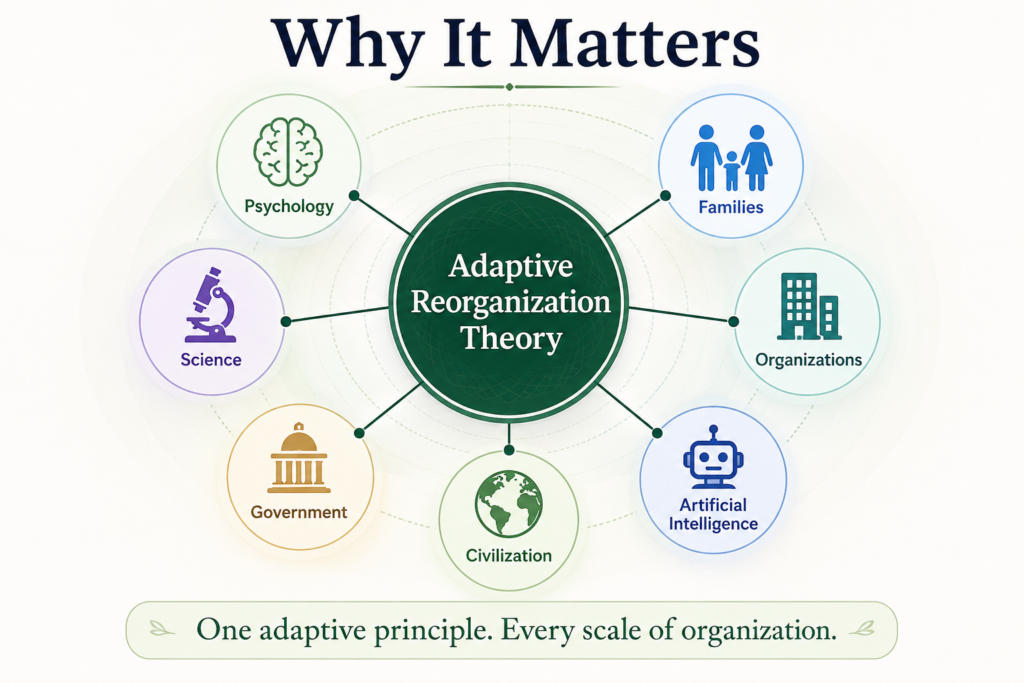
Adaptive Reorganization Theory proposes that this recurring pattern appears across biology, psychology, organizations, science, governments, civilizations, and intelligent systems. If true, understanding this principle matters wherever adaptation matters.
Why It Matters for Individuals
Every person develops successful habits. Those habits become routines. Routines become identity. Identity provides stability, yet identity can also become increasingly resistant to correction. ART asks how individuals preserve lifelong adaptability without sacrificing coherence.
Why It Matters for Families
Healthy families require both stability and flexibility. Too little stability produces chaos while too much stability suppresses curiosity, honest communication, and growth. ART explores how families remain capable of continually reorganizing themselves while preserving trust and belonging.
Why It Matters for Organizations
Organizations succeed by creating reliable procedures. Those procedures gradually become bureaucracy. Innovation slows, feedback narrows, and competency becomes rigidity. ART explains why organizational success naturally creates resistance to future adaptation—and what conditions preserve long-term learning.
Why It Matters for Science
Science advances because theories remain open to correction, yet successful paradigms inevitably accumulate institutions, incentives, careers, and assumptions that resist revision. Scientific progress depends not simply on discovery, but on preserving the capacity for continual adaptive reorganization.
Why It Matters for Government
Stable governments require institutions. Adaptive governments require institutions capable of learning. History repeatedly demonstrates that societies become vulnerable whenever preserving existing organization becomes more important than responding to changing reality. ART examines the adaptive conditions required for long-term societal resilience without advocating a particular political ideology.
Why It Matters for Civilization
Every civilization eventually confronts the same question: “Can success remain reorganizable?”
History suggests that civilizations rarely collapse because they stop solving problems. More often they continue solving yesterday’s problems while reality creates new ones. Understanding adaptive reorganizability may become one of the defining challenges of the twenty-first century.
Why It Matters for Artificial Intelligence
Artificial intelligence introduces a new participant into adaptive systems. The question is no longer simply whether machines become more intelligent, it is whether increasingly intelligent human-AI systems remain capable of continual adaptive reorganization. Optimization alone may not be enough. Participation may matter more.
Why It Matters for the Future
Most theories explain success while others explain failure. Adaptive Reorganization Theory asks a different question:
How do successful adaptive systems remain capable of continual adaptation?
If that question has a general answer, it could influence how we think about education, leadership, psychotherapy, organizations, science, governance, civilization, and artificial intelligence.
The Larger Vision
ART proposes that adaptation depends upon more than intelligence, development, harmony, or complexity. It depends upon preserving the continual capacity for successful organization to reorganize itself in response to changing reality. That possibility has implications wherever adaptive systems exist.
The question is not whether change will occur. Change is inevitable. The deeper question is whether successful adaptive systems can remain open to being reorganized by reality before reality reorganizes them through crisis.