Why Sharing Integral Deep Listening With Children and Adolescents Is Important
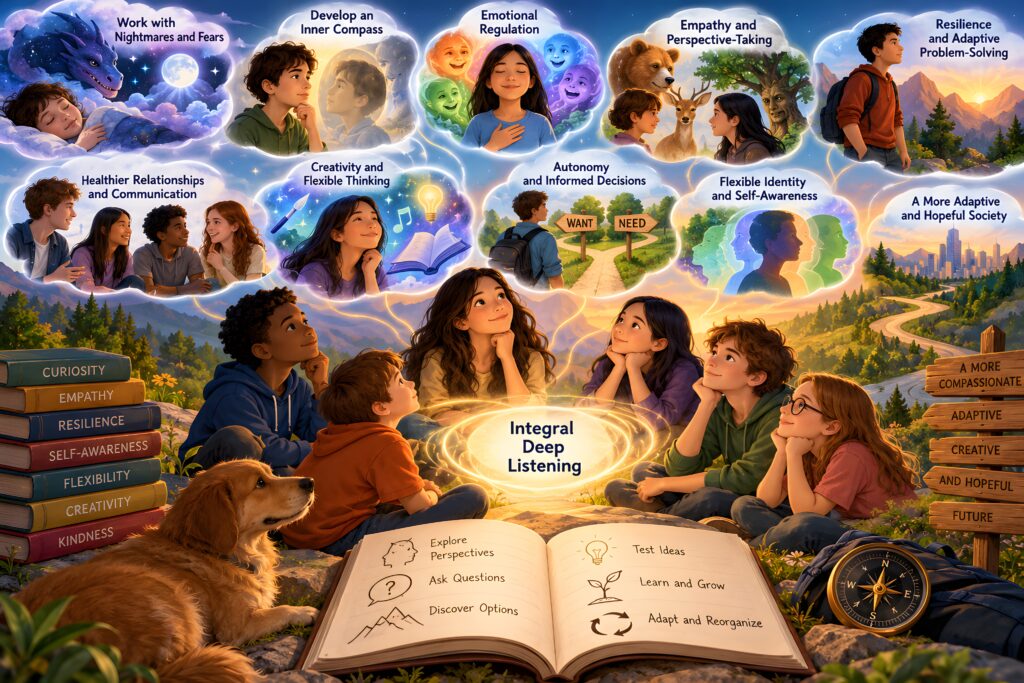
Joseph Dillard/ChatGPT
Children and adolescents are constantly learning how to understand themselves, relate to others, respond to difficulties, and make decisions. Much of this learning occurs through imitation, instruction, reward, punishment, and the expectations of parents, teachers, peers, and society. These influences are necessary for development, but they can also encourage young people to identify with ways of thinking, feeling, and behaving that eventually limit their ability to adapt.
Integral Deep Listening (IDL) offers a complementary approach. Rather than simply telling children and adolescents what to think, feel, or do, it teaches them how to explore their experiences from different perspectives, listen to what those perspectives have to say, and test potentially helpful recommendations in everyday life.
IDL does not require children to accept particular psychological theories, spiritual beliefs, or interpretations of their dreams. It invites curiosity, experimentation, and learning through experience. Its potential value extends beyond resolving immediate difficulties to developing capacities that may serve young people throughout their lives.
Helping Children and Adolescents Develop Their Own Life Compass
Children depend on adults for guidance, protection, and instruction. However, healthy development also involves gradually learning to evaluate experiences and make decisions independently. Young people who rely exclusively on external approval may become skilled at meeting expectations without developing confidence in their own judgment.
IDL encourages children and adolescents to discover perspectives that may offer insights different from those of parents, teachers, friends, or their familiar sense of themselves. By interviewing a dream character, an animal, an imaginary figure, or something associated with a waking-life problem, they can encounter alternative ways of understanding their circumstances.
The objective is not to replace adult guidance with the authority of an imagined character. It is to help young people develop an internal process for considering alternatives, evaluating recommendations, and discovering what actually works. Over time, this can support the development of a Life Compass: an increasingly reliable capacity to navigate experience through listening, discrimination, experimentation, and feedback.
Reducing Psychological Geocentrism Before It Becomes Entrenched
Psychological geocentrism is the tendency to experience one’s familiar identity, assumptions, preferences, and emotional reactions as the natural center of reality. Adults often become so identified with their established perspectives that alternatives appear threatening, irrelevant, or simply wrong.
Children and adolescents are still developing their identities. This creates opportunities to learn that their current perspective is important without necessarily being the only valid one.
When a child interviews a frightening dream monster and discovers that it experiences the situation differently, the child may begin to recognize that fear is not the only possible response. When an adolescent interviews a figure representing a conflict with a parent, that figure may introduce considerations the adolescent had previously overlooked.
These experiences can encourage a shift from psychological geocentrism toward polycentrism: the capacity to recognize and consider multiple perspectives without losing the ability to make decisions. Rather than waiting until rigid patterns become established in adulthood, IDL offers young people opportunities to practice flexibility while their identities are still developing.
Teaching Emotional Regulation Without Suppressing Emotions
Children and adolescents frequently experience emotions that seem overwhelming. Fear, anger, jealousy, embarrassment, sadness, and frustration can temporarily dominate their awareness. Adults often respond by telling them to calm down, behave appropriately, or control themselves. Although such guidance can be necessary, it does not always teach young people how to relate differently to their emotions.
IDL introduces another possibility. A child who is frightened by a nightmare can interview a character from the dream. An adolescent who is angry about being excluded by friends can explore the situation from the perspective of a relevant dream or imagined figure.
The purpose is not to eliminate difficult emotions or declare them irrational. Instead, the interview creates some distance between the young person and the immediate emotional reaction. This temporary distancing may make it easier to recognize feelings without being completely controlled by them.
With practice, children and adolescents may learn that they can experience strong emotions while remaining curious, reflective, and capable of choosing how to respond. This is an important foundation for emotional self-regulation.
Developing Empathy Through Direct Experience Rather Than Moral Instruction
Adults frequently tell children to consider other people’s feelings. However, knowing that empathy is desirable is different from actually experiencing the world from another perspective.
IDL makes perspective-taking an experiential activity. When children imagine being a dream animal, a tree, a monster, a friend, or even an object, they are invited to describe what that perspective experiences, values, fears, and wants.
This differs from simply asking children to imagine what another person might think. The interviewed perspective may respond in unexpected ways, challenging the child’s assumptions about the situation.
For example, a child who interviews a threatening dream dog might discover that the dog is frightened, lonely, or attempting to protect something. The child does not have to believe that this explanation is objectively true. The developmental value lies in discovering that a threatening situation can sometimes be understood in more than one way.
Such experiences provide opportunities to develop empathy without requiring agreement, submission, or the abandonment of personal boundaries.
Helping Young People Work With Nightmares and Fears
Nightmares can be especially disturbing for children because the experiences may feel intensely real. A frightening dream can affect bedtime, sleep quality, confidence, and feelings of safety.
Adults commonly reassure children that dreams are not real or encourage them to forget frightening experiences. While reassurance can help, it may not address the child’s continuing emotional response.
IDL offers a different approach by inviting the child to interview a dream character, including one that initially appears threatening. The child might become the monster, animal, or other dream figure and answer questions from its perspective.
A frightening figure may turn out to have unexpected motivations, abilities, or recommendations. Sometimes the child discovers new ways of responding to the original dream situation.
The important point is that the child is no longer limited to being the frightened observer or victim. The child can experiment with alternative perspectives and responses.
IDL should not be presented as a guaranteed treatment for nightmares, and persistent or trauma-related nightmares may require professional assessment. Nevertheless, perspective interviewing offers a potentially useful way to explore frightening dream experiences while supporting curiosity and a sense of agency.
Strengthening Resilience by Changing the Relationship to Problems
Resilience is often understood as the ability to endure difficulties, recover from setbacks, and continue functioning despite adversity. However, resilience can also involve recognizing when an established response is no longer useful and discovering alternatives.
Children may respond to difficulties by withdrawing, becoming aggressive, seeking reassurance, blaming themselves, or attempting to control their circumstances. Some of these responses work well in particular situations but become restrictive when applied automatically.
IDL invites young people to explore problems without immediately defending their familiar responses.
A child who feels rejected may discover a perspective that values independence. An adolescent overwhelmed by academic expectations may encounter a perspective that questions whether achievement should determine personal worth.
These experiences do not automatically produce resilience. Their potential value emerges when young people test useful recommendations and discover that they have more than one way of responding to difficulties.
Reducing Dependence on Peer Approval and Social Comparison
Adolescence is a period when belonging, recognition, and social acceptance can become especially important. Young people may organize their behavior around peer expectations, appearance, popularity, academic performance, or social media approval.
The desire to belong is normal and developmentally important. Problems arise when external approval becomes the primary measure of personal worth.
IDL can help adolescents examine the assumptions underlying their need for acceptance. For example, an adolescent concerned about being unpopular might interview a dream character that appears indifferent to social status or values something entirely different.
Such an interview may reveal alternative ways of organizing self-worth and belonging. The adolescent can then consider whether these alternatives are useful and test them in ordinary social situations.
The objective is not to encourage indifference toward others. It is to help young people develop relationships without becoming completely dependent on external confirmation of their value.
Supporting Autonomy Without Encouraging Rebellion for Its Own Sake
Adolescents need increasing independence, but autonomy is often confused with opposition to authority. A young person may reject parental or institutional expectations while remaining strongly controlled by peer pressure, emotional reactions, or the need to appear independent.
IDL encourages a more reflective form of autonomy.
Rather than automatically accepting or rejecting an instruction, adolescents can learn to examine a situation from multiple perspectives, identify competing values, and consider the likely consequences of different responses.
An adolescent who disagrees with a parent might interview a perspective that values freedom, another that values security, and another that values cooperation. The resulting insights may help the adolescent recognize that autonomy does not necessarily require conflict.
The goal is to strengthen the ability to make informed decisions while maintaining appropriate relationships and responsibilities.
Improving Communication Between Children, Adolescents, and Adults
Many conflicts between young people and adults involve competing assumptions about what matters. Parents may prioritize safety, responsibility, or long-term consequences, while children prioritize immediate experiences, fairness, autonomy, or belonging.
When adults assume that they already understand a child’s experience, important information can be overlooked.
IDL encourages adults to listen without immediately interpreting, correcting, or evaluating what the child says. During an interview, the adult’s task is to help the young person articulate the perspective being explored rather than impose an explanation.
This can create opportunities for children to express experiences that they might otherwise find difficult to communicate.
Parents may also discover that a child’s unusual or unexpected responses contain information relevant to family relationships. The process can therefore become reciprocal: adults learn about children’s experiences while children learn that their perspectives can be taken seriously.
This does not eliminate the need for parental authority or protective boundaries. It introduces a way for children’s experiences to inform adult decisions.
Encouraging Creativity and Flexible Problem-Solving
Children naturally engage in imaginative play, storytelling, and experimentation with different identities. These activities provide opportunities to explore possibilities beyond immediate circumstances.
IDL builds upon these capacities by giving imaginative perspective-taking a practical purpose.
A child struggling with a school problem might interview an animal that approaches obstacles differently. An adolescent facing a difficult decision might explore the perspective of a dream figure with unfamiliar priorities.
The value of such experiences does not depend on treating the interviewed figures as independently existing entities. Their usefulness depends on whether they generate possibilities that would otherwise remain unexplored.
IDL can therefore serve as a structured exercise in creative problem-solving, encouraging young people to generate alternatives before deciding which ones deserve consideration or testing.
Teaching Critical Thinking Without Undermining Imagination
Children are frequently encouraged either to trust their imagination or to distinguish imagination from reality. These are not necessarily competing objectives.
IDL allows young people to take imaginative experiences seriously without requiring them to interpret those experiences literally.
A dream character may offer advice, but that advice is not automatically correct. An imaginary figure may express an unfamiliar viewpoint, but the young person remains responsible for deciding whether its recommendations are appropriate.
This distinction is particularly important for adolescents, who are developing more sophisticated capacities for reflection, evaluation, and independent judgment.
IDL can teach a practical form of critical thinking: listen openly, consider alternatives, examine consequences, and test recommendations rather than accepting them merely because they seem impressive, comforting, or unusual.
Helping Children Recognize and Question Unhelpful Identity Labels
Children and adolescents often acquire identities through repeated experiences and social feedback. A child may come to believe, “I am shy,” “I am bad at mathematics,” “I am the difficult one,” or “Nobody likes me.”
Such descriptions may begin as responses to particular circumstances but eventually become organizing assumptions that influence future behavior.
IDL offers opportunities to experience identity as more flexible.
A child who identifies as timid may interview a courageous dream character. An adolescent who believes they are incapable of leadership may explore the perspective of a figure that demonstrates confidence or initiative.
The objective is not to replace negative labels with unrealistically positive ones. It is to help young people discover that no single description necessarily exhausts their capacities.
This flexibility may reduce the likelihood that temporary difficulties become permanent limitations on identity.
Teaching Young People How to Learn From Mistakes
Children are often evaluated according to whether their answers and behavior are correct. Grades, discipline, praise, and social approval can unintentionally teach them that mistakes threaten their worth or belonging.
IDL introduces a different relationship to error.
A recommendation from an interviewed perspective is treated as a possibility to investigate, not a command to obey. If the young person tests a suggestion and discovers that it does not help, the result becomes useful information.
This approach encourages experimentation without requiring certainty in advance.
For example, an adolescent might test a recommendation to communicate more directly with a friend. If the conversation goes poorly, the next question is not simply whether the adolescent failed. It is what the experience revealed and what might be changed.
Learning to treat mistakes as feedback rather than identity-threatening failures can support lifelong adaptability.
Developing the Capacity for Adaptive Reorganization
One of the most important potential contributions of IDL is helping children and adolescents develop the capacity to change patterns that have previously worked but are becoming restrictive.
A child may learn that pleasing adults produces approval. An adolescent may discover that academic achievement brings recognition. Another may become successful at avoiding conflict.
These strategies can be useful. However, if they become rigid, they may eventually interfere with autonomy, relationships, emotional well-being, or personal development.
Adaptive Reorganization Theory (ART) examines how successful patterns become established, how changing circumstances expose their limitations, and how systems may reorganize in response.
IDL offers a practical way to explore this process.
Young people learn to recognize a difficulty, temporarily loosen identification with their familiar response, invite alternative perspectives, evaluate recommendations, test selected changes, and observe the results.
The long-term objective is not constant change. It is the ability to preserve what remains useful while becoming more capable of reorganizing what no longer works.
Giving Children and Adolescents a Voice in Decisions That Affect Them
Adults generally control the environments in which children develop. They determine many of the rules, schedules, educational expectations, and family arrangements that shape young people’s daily experiences.
Much of this authority is necessary. However, adults can overlook important information when children have little meaningful influence over decisions affecting them.
IDL provides a structured opportunity for young people to articulate experiences and concerns that adults may not anticipate.
A child who resists going to school might interview a dream character or an imagined perspective associated with the problem. The resulting interview could reveal concerns about belonging, fear of failure, exhaustion, or something else entirely.
The adult does not have to accept every recommendation. Nevertheless, the interview may provide information that deserves consideration.
When children discover that their experiences can influence appropriate decisions, they may develop greater confidence, responsibility, and willingness to participate constructively in family and educational life.
Preparing Young People for Relationships Based on Reciprocity
Healthy relationships require more than empathy. They also involve recognizing differences, negotiating competing needs, respecting boundaries, and allowing others’ experiences to influence one’s own behavior.
IDL can provide practice in these capacities.
When young people interview unfamiliar perspectives, they encounter viewpoints that may challenge their assumptions. They learn to ask questions, listen to responses, and consider recommendations without immediately imposing their preferred conclusions.
This process can support reciprocity: the recognition that relationships involve mutual influence rather than unilateral control.
For adolescents beginning to form more independent friendships and romantic relationships, such capacities may be particularly valuable.
The aim is not to teach young people to accommodate everyone else’s wishes. It is to develop the ability to remain autonomous while recognizing the legitimate needs and perspectives of others.
Introducing a Practical Form of Mindfulness and Self-Reflection
Mindfulness is often taught through attention to breathing, bodily sensations, thoughts, or emotions. These practices can be valuable, but some children and adolescents find sustained observation difficult or uninteresting.
IDL offers an interactive form of reflective attention.
During an interview, young people temporarily set aside familiar assumptions and become curious about the experiences of another perspective. They practice listening, noticing emotional reactions, and allowing unfamiliar responses to emerge.
This resembles certain functions of mindfulness, particularly the capacity to observe experience without immediately identifying with or reacting to it.
Because the process involves imagination, dialogue, and personal relevance, it may be more engaging for some young people than purely observational exercises.
IDL should not be considered interchangeable with established mindfulness interventions, but it offers another way to practice reflective awareness.
Helping Young People Distinguish Between What They Want and What They Need
Children and adolescents understandably focus on immediate desires. They may want approval, entertainment, independence, possessions, achievement, or relief from discomfort.
Adults often attempt to teach the difference between short-term gratification and long-term well-being through instruction or consequences.
IDL can make this distinction more experiential.
An adolescent who wants to avoid an uncomfortable conversation might interview a perspective that values honesty or long-term friendship. A child who wants to win every competition might encounter a perspective that values cooperation or enjoyment.
These experiences may reveal that different perspectives prioritize different outcomes.
The young person can then consider whether immediate preferences are consistent with broader goals and relationships.
The objective is not to suppress desires but to develop greater freedom in deciding which desires deserve priority.
Helping Young People Develop Psychological Flexibility Before Crises Occur
Psychological interventions are frequently introduced after difficulties have become serious. Children may receive support only when anxiety, behavioral problems, family conflicts, or academic difficulties become disruptive.
IDL can also be introduced as an educational and developmental practice before significant problems arise.
Learning to explore perspectives, recognize assumptions, and test alternatives may help young people approach ordinary challenges with greater flexibility.
A child who has practiced interviewing dream characters may find it easier to approach a frightening experience with curiosity. An adolescent accustomed to examining competing perspectives may be better prepared to reconsider an unhelpful social or academic strategy.
These are plausible developmental benefits rather than established outcomes of IDL-specific research. Their importance lies in the possibility of teaching adaptive capacities proactively rather than exclusively in response to distress.
Teaching a Lifelong Method for Navigating Change
The circumstances in which today’s children and adolescents will live as adults are uncertain. Technological change, environmental pressures, economic transformations, and shifting social expectations may require repeated adjustments throughout their lives.
Education necessarily teaches knowledge and skills, but particular knowledge and skills can become outdated.
A complementary educational objective is to teach young people how to recognize when familiar approaches are no longer sufficient.
IDL offers a repeatable process: identify a problem, suspend habitual assumptions, explore alternative perspectives, evaluate possibilities, test selected recommendations, and learn from the results.
Young people do not need to master psychological theory to begin practicing this process.
Its potential long-term value is that it can become a familiar way of responding to uncertainty, disagreement, failure, and change.
Rather than assuming that successful adaptation means finding the right answer once and preserving it indefinitely, young people can learn that adaptation is an ongoing process.
Allowing Children to Become Contributors to Adult Learning
Adults typically assume that they are responsible for teaching children. While this is often appropriate, it can obscure the possibility that children sometimes notice things adults overlook.
Children may be less invested in established interpretations, social conventions, or explanations of why things must remain as they are. Their perspectives can therefore reveal assumptions that adults have stopped questioning.
IDL creates opportunities for adults to encounter these perspectives without immediately correcting or translating them into familiar categories.
For example, a child’s interview with a dream character might reveal an unexpected understanding of a family conflict. The child’s account may not provide a complete or accurate explanation, but it could introduce information that deserves attention.
When adults take such contributions seriously, learning becomes more reciprocal.
When adults have children interview them, waking roles are temporarily dissolved and reciprocal relationships based on autonomy and intimacy, yet are interdependent, are strengthened.
Children discover that they can contribute to the understanding of adults, while adults practice questioning the assumption that maturity automatically provides the most complete perspective.
Supporting the Development of a More Adaptive Society
The potential importance of teaching IDL to children and adolescents extends beyond individual psychological well-being.
Societies depend upon people who can cooperate, recognize competing interests, question established assumptions, respond to evidence, and revise arrangements that are no longer working.
Yet many educational and social environments reward conformity, competition, certainty, and the defense of established identities.
IDL offers opportunities to practice complementary capacities: curiosity, perspective-taking, independent judgment, reciprocity, and willingness to test alternatives.
If such capacities become part of how young people approach relationships, institutions, and public disagreements, they may contribute to more adaptive forms of social participation.
This possibility should not be confused with a demonstrated societal effect of IDL. It is a developmental hypothesis that deserves investigation.
Nevertheless, it raises an important question: What might change if children learned not only how to succeed within existing arrangements, but also how to recognize when those arrangements need to change?
⸻
Why Begin With Children and Adolescents?
Adults often seek psychological help after years or decades of repeating patterns that once worked but have become restrictive. Their identities, relationships, careers, and expectations may already be organized around those patterns. Changing them can threaten much of what they have invested in becoming.
Children and adolescents are also shaped by established patterns, but many of their habits and identities are still developing. This creates opportunities to practice alternative ways of relating to experience before familiar responses become deeply entrenched.
IDL does not promise to prevent psychological difficulties, eliminate conflict, or guarantee adaptive development. Nor should it replace effective educational practices, appropriate parental guidance, or professional psychological care when needed.
Its contribution is more specific. It offers young people a way to discover that their familiar perspectives are not necessarily the only perspectives available to them. It teaches them to listen without immediately agreeing, question without automatically rejecting, imagine without abandoning critical judgment, and experiment without requiring certainty.
Perhaps most importantly, IDL introduces the possibility that personal development is not simply a matter of becoming increasingly successful at being who we already think we are.
It can also involve discovering who else we might become.
The purpose of sharing IDL with children and adolescents is not to tell them who they should be. It is to help them develop the capacity to discover, evaluate, and reorganize who they are becoming.
More information about IDL is available at IntegralDeepListening.Com, AdaptiveReorganizationTheory.Com, and DreamYoga.Com.