The Adaptive Cycle
Every adaptive system must solve two competing problems.
It must preserve successful organization long enough to remain effective, yet continually reorganize itself as reality changes.
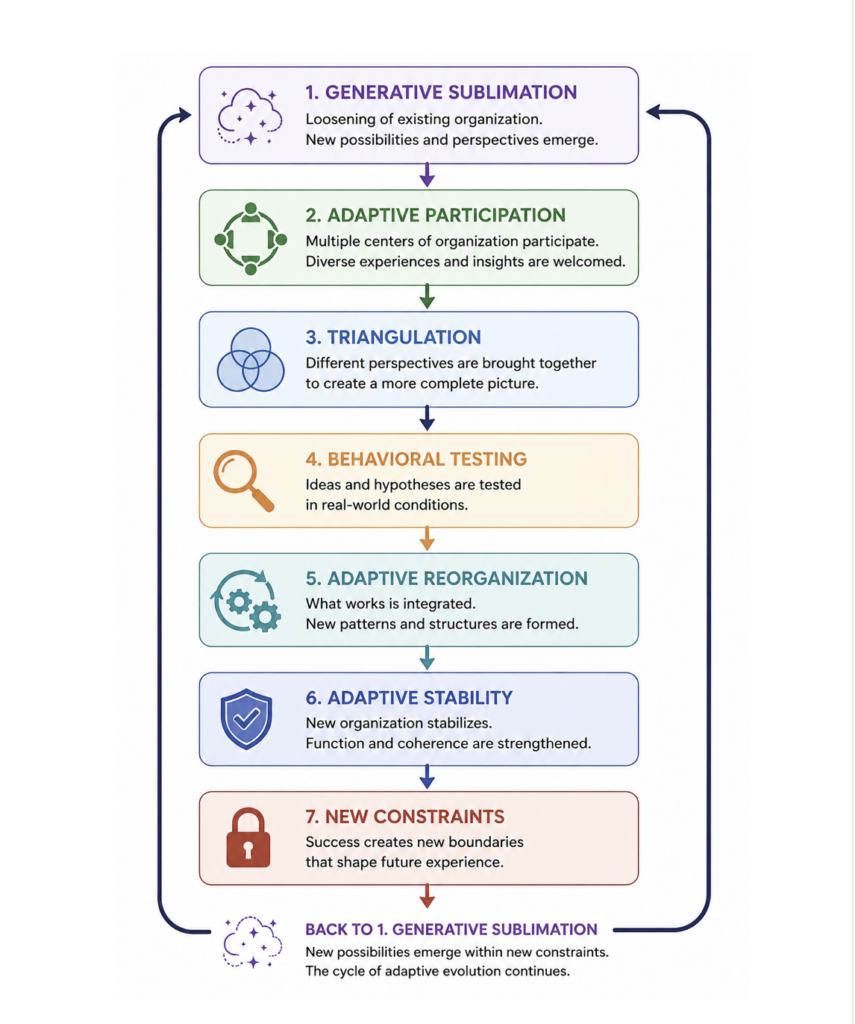
Adaptive Reorganization Theory proposes that these two requirements create a recurring adaptive cycle.
The cycle begins with Generative Sublimation, in which existing organization temporarily loosens. New ideas, behaviors, relationships, or perspectives become possible. This generates adaptive variability—the raw material for future adaptation.
Through Adaptive Participation, multiple relatively autonomous centers of organization contribute information, experience, and corrective feedback. Rather than relying on a single perspective, adaptive systems expand the range of possibilities available for selection.
Not every possibility proves useful. Adaptive Selection preserves those reorganizations that better fit changing conditions while allowing less successful alternatives to disappear.
Successful reorganizations gradually become Adaptive Stability. Stable organization makes coordinated action, learning, and long-term achievement possible. Stability is therefore not a problem but an adaptive necessity.
Over time, however, successful stability becomes new constraints. Habits, identities, institutions, and assumptions increasingly resist correction. The very strengths that created success gradually reduce reorganizability.
At this point the cycle must begin again. New rounds of generative sublimation reopen adaptive space, allowing reality once again to reorganize successful organization before excessive rigidity develops.
The cycle therefore illustrates ART’s central principle:
Long-term adaptation depends not only on becoming successful, but on preserving the continual capacity to reorganize success itself.