
Psychological Geocentrism as Inner Hegemony
Consequences for the Future of Human Adaptability
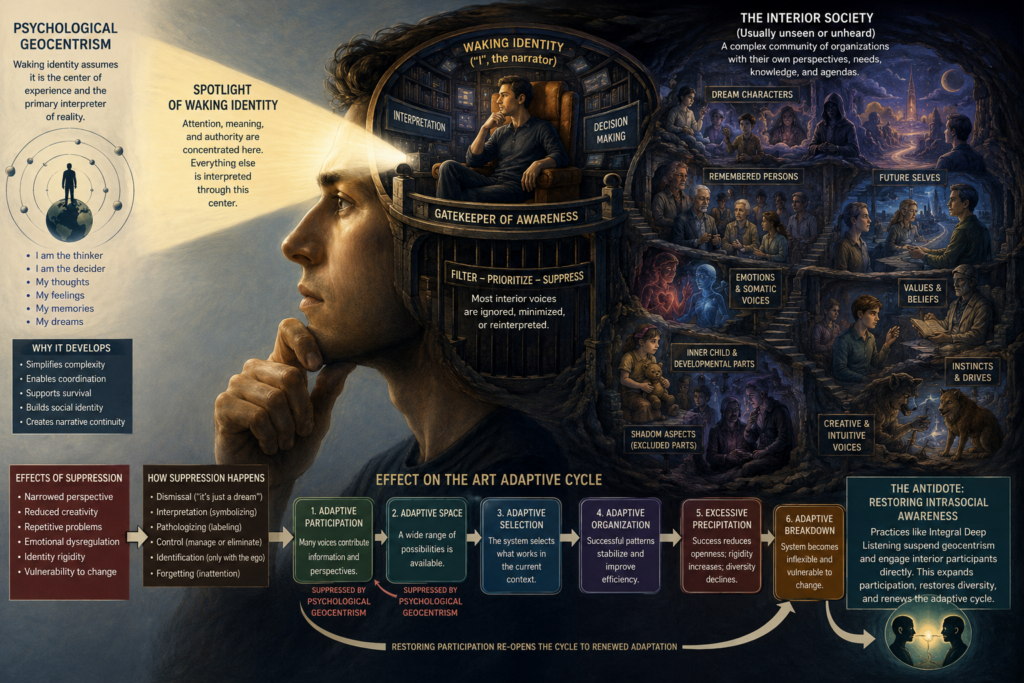
Adaptive Reorganization Theory proposes that every human being participates simultaneously in two social worlds.1 One is the familiar social world studied by sociology: relationships among externally existing people, institutions, and cultures. The other is an interior social world composed of remembered persons, anticipated future selves, dream characters, symbolic figures, bodily processes, values, emotions, identities, and other organized centers of experience that continually influence perception, judgment, and behavior. Intrasociology is the study of this interior society.
Psychological Geocentrism
If interior society exists, however, an obvious question immediately arises. Why is it so difficult to perceive? The answer proposed by Adaptive Reorganization Theory is psychological geocentrism.2 Just as astronomical geocentrism mistakenly assumed that the universe revolved around the Earth, psychological geocentrism assumes that waking identity is the center around which all experience revolves. Waking identity naturally experiences itself as the primary subject, decision-maker, interpreter, and owner of consciousness.3 Everything else appears secondary: dreams become “my dreams,” emotions become “my emotions,” thoughts become “my thoughts,” memories become “my memories,” and even internal dialogue is interpreted as something the waking self is generating rather than participating within.
The Importance and Necessity of Psychological Geocentrism
This assumption is extraordinarily useful.4 It allows coherent planning, personal continuity, social responsibility, and rapid decision-making. Without a relatively stable center of organization, everyday functioning would become extremely difficult, yet precisely because it is so adaptive under ordinary circumstances, psychological geocentrism also obscures the complex interior society from which waking identity itself emerges.
Historical Forerunners
Numerous traditions have pointed toward this conclusion, even when using very different language. William James distinguished between the experiencing “I” and the experienced “Me,” suggesting that what appears to be a unified self actually consists of multiple functions rather than a single indivisible entity.5 George Herbert Mead later demonstrated that identity develops through internalized social interaction, proposing that the self itself emerges from taking the perspectives of others.6 Erving Goffman extended this insight by showing that social identity consists of continually shifting performances adapted to different audiences.7 These perspectives collectively weaken the assumption that waking identity is a singular, fixed organizer and instead portray it as a dynamic social construction.
Support from Neuroscience
Research on the brain’s default mode network suggests that the narrative self is not a permanent executive residing somewhere in the brain but a dynamically maintained pattern integrating autobiographical memory, future simulation, social understanding, and self-referential processing.8 Rather than locating a central controller, neuroscience increasingly identifies distributed networks that continually construct the experience of being a coherent self.1
Support from Contemporary Theorists
Daniel Dennett famously described the self as a “center of narrative gravity” rather than a substantial entity.9 Thomas Metzinger similarly argues that consciousness contains a self-model that functions so transparently that we mistake the model for an independently existing self.10 According to his Self-Model Theory, consciousness does not discover a self; it constructs one. This construction normally remains invisible precisely because it operates continuously and automatically.2
Psychology likewise provides abundant evidence that conscious awareness represents only a small portion of ongoing cognition.11 Kahneman’s distinction between fast and slow thinking, dual-process models of reasoning, research on unconscious priming, predictive processing, implicit memory, emotional appraisal, and attentional selection all demonstrate that conscious identity frequently receives completed products rather than participating in their generation. Decisions are often initiated before conscious awareness recognizes them. Perception is actively constructed rather than passively received. Much of what waking identity experiences as voluntary thought consists of post hoc interpretation rather than original authorship.
The Relative Autonomy of Dream Elements
Dream research adds another important dimension. During dreaming, the stability of waking identity is dramatically reduced. Dream characters frequently display independent knowledge, motivations, personalities, emotional reactions, and perspectives unavailable to your Dream Self.12 Conventional dream theories often interpret these figures symbolically, yet their phenomenology is unmistakably social. The dreamer encounters conversations, disagreements, negotiations, alliances, authority figures, strangers, children, animals, landscapes, and even abstract processes behaving as organized participants rather than passive mental images.
Recent philosophical work on dreaming has increasingly questioned the assumption that dreams merely represent degraded waking cognition.13 Dream consciousness appears to possess its own forms of organization, agency, and self-regulation, even when autobiographical continuity is substantially altered.
From the perspective of intrasociology, this observation is crucial. Dreams reveal not simply unconscious content but organized interior participation. They expose a social complexity that waking identity ordinarily suppresses.
Why does waking consciousness suppress awareness of this interior society?
Part of the answer appears to lie in the adaptive advantages of centralized organization.14 Complex adaptive systems often require temporary coordination around relatively stable control structures. Organizations appoint executives. Governments establish leadership. Nervous systems prioritize certain information while suppressing competing signals. Excessive decentralization can impair rapid coordinated action.
Waking identity functions similarly.15 It simplifies enormous informational complexity into a manageable narrative centered upon a single protagonist. The brain’s default mode network appears particularly involved in maintaining this autobiographical center by integrating memory, social meaning, future simulation, and self-reference into a coherent ongoing story. (Nature)
How Psychological Geocentrism Leads to Excessive Precipitation
This simplification is extraordinarily adaptive—until it becomes excessively rigid. Adaptive Reorganization Theory proposes that psychological geocentrism gradually transforms useful coordination into excessive precipitation.16 The more successfully waking identity organizes experience around itself, the more alternative interior organizations become ignored, marginalized, or actively suppressed. Interior diversity decreases. Adaptive participation narrows.
This process resembles developments observed throughout sociology.17 Organizations initially succeed because they coordinate multiple specialized participants. Over time, however, successful hierarchies often centralize authority, suppress dissent, eliminate redundancy, discourage innovation, and increasingly identify organizational stability with organizational survival. What once enhanced adaptation eventually reduces reorganizability. The same principle appears to operate within consciousness.
Development Typically Reduces Generative Sublimation while increasing Psychological Geocentrism
Children often demonstrate remarkable flexibility in imagination, play, role-taking, emotional expression, and perspective shifting. Development gradually strengthens narrative identity, executive function, social roles, and autobiographical continuity.18 These capacities are indispensable for mature functioning. Yet they also increase identification with waking identity as the sole legitimate center of experience. Dreams become dismissed as fantasies. Intuitions become irrational impulses. Bodily knowledge becomes background noise. Future selves become abstract planning exercises rather than participants. Remembered persons become static memories rather than continuing relational organizations. The interior society remains active but becomes progressively less represented within conscious decision-making.
Profound Consequences for the Adaptive Reorganization Theory Adaptive Cycle.
The adaptive cycle begins with adaptive participation: broad engagement with multiple relevant centers of organization.19 Adaptive participation generates adaptive space by expanding the range of information, perspectives, temporal horizons, developmental levels, and organizational possibilities available for selection. Adaptive selection then operates upon this enlarged space, preserving solutions that increase adaptive fit. Repeated successful selection produces adaptive organization, allowing increasingly efficient performance.
Organization, however, always carries risk. Success encourages stabilization. Stabilization gradually becomes precipitation as successful patterns resist modification. Excessive precipitation narrows adaptive participation because increasingly fewer organizations are permitted meaningful influence over ongoing adaptation. Psychological geocentrism accelerates precisely this narrowing.20
As waking identity becomes increasingly convinced that it alone represents reality, participation from the broader interior society diminishes. Dreams are interpreted instead of interviewed. Emotions are managed instead of consulted. Symptoms are eliminated instead of understood. Marginalized perspectives become pathologized rather than explored. Identity becomes less polycentric and more authoritarian. Adaptive space correspondingly contracts.
Selection now occurs within an increasingly restricted range of possibilities. Although intelligence may remain high, creativity declines because genuinely novel reorganizations require participation from organizations lying outside established identity. Learning becomes confirmation rather than discovery. The adaptive cycle begins feeding back upon itself, reinforcing existing organization while losing access to corrective participation. Eventually the system becomes highly optimized for yesterday’s environment while increasingly incapable of reorganizing for tomorrow’s.
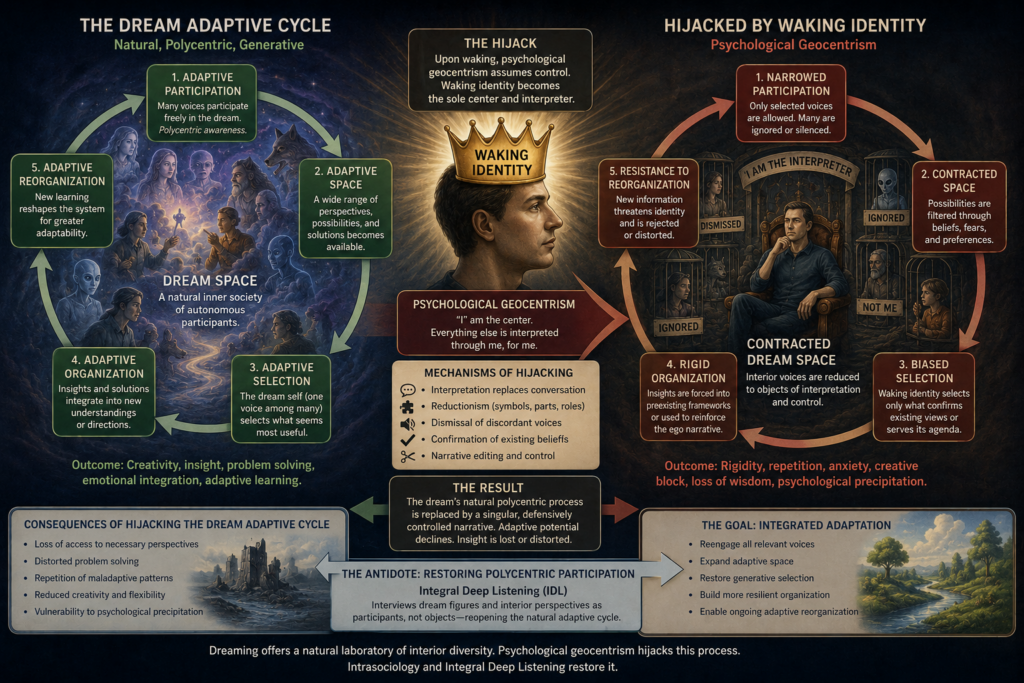
This analysis suggests that psychological geocentrism represents far more than an interesting cognitive illusion. It functions as one of the principal mechanisms through which adaptive systems become excessively precipitated.
How IDL Interrupts Psychological Geocentrism
Integral Deep Listening was developed specifically to interrupt this process.21 Rather than treating waking identity as the unquestioned authority interpreting every interior event, IDL temporarily suspends psychological geocentrism through epoché. Dream characters, remembered persons, bodily symptoms, emotions, future selves, and other organizations are interviewed directly without prematurely reducing them to symbolic extensions of waking identity. Whether these participants ultimately prove neurological constructions, symbolic organizations, autonomous psychological systems, or something else remains deliberately unanswered. What matters operationally is whether their participation expands adaptive space and increases adaptive reorganizability.
In this sense, IDL functions as an intervention in interior sociology. It attempts to restore adaptive participation to organizations that psychological geocentrism has marginalized.
The broader implication is striking. Sociology teaches that societies become healthier when participation expands beyond centralized authority into genuinely responsive networks of communication. Intrasociology suggests that consciousness follows the same principle. Psychological health may depend not primarily upon strengthening the self but upon reorganizing the interior society so that many centers of organization can participate in adaptive decision-making.
Psychological geocentrism therefore resembles every successful adaptive innovation that eventually becomes excessive.22 It begins as an indispensable organizer of experience. It becomes problematic only when it mistakes itself for the whole society. The tragedy of excessive precipitation is not that the waking self becomes too strong. It is that it becomes too alone.
For the application of Intrasociology in IDL, see IntegralDeepListening.Com.
Notes
1. Adaptive Reorganization Theory extends sociology by proposing that human beings participate simultaneously in two organized social domains: external society and an interior society composed of relatively autonomous centers of organization. Whereas sociology studies relationships among persons, intrasociology studies relationships among interior organizations. This distinction constitutes an original contribution of ART.
2.Psychological geocentrism is introduced here as an original concept within Adaptive Reorganization Theory. The analogy is drawn deliberately from astronomical geocentrism. Just as pre-Copernican astronomy mistakenly treated Earth as the center of the cosmos, psychological geocentrism refers to waking identity’s tendency to assume itself to be the center around which all experience is organized.
3. Numerous psychological traditions have questioned the unity of the self while recognizing the phenomenological dominance of waking identity. ART argues that this dominance is functionally adaptive but becomes maladaptive when treated as absolute.
4. Executive organization is indispensable for coherent planning, moral responsibility, language, and coordinated behavior. The argument presented here is not against centralized organization itself but against its excessive stabilization. Adaptive systems require both organization and reorganizability.
5. William James distinguished between the experiencing “I” and the experienced “Me,” suggesting that consciousness already contains an internal distinction between observer and observed. See William James, The Principles of Psychology (1890).
6. George Herbert Mead argued that the self develops through internalized social interaction, making identity fundamentally social rather than purely individual. See George Herbert Mead, Mind, Self, and Society (1934).
7. Erving Goffman’s dramaturgical sociology portrays identity as a succession of socially situated performances rather than a fixed essence. See Erving Goffman, The Presentation of Self in Everyday Life (1959).
8. Neuroscientific research increasingly views the Default Mode Network as an integrative network supporting autobiographical memory, future simulation, self-reference, and social cognition rather than housing a central executive self. See Joseph Smallwood et al., “The Default Mode Network in Cognition,” Nature Reviews Neuroscience 22 (2021): 503–513.
9. Daniel Dennett proposes that the self is a “center of narrative gravity” constructed through interpretation rather than an independently existing entity. See Daniel Dennett, Consciousness Explained (1991).
10. Thomas Metzinger argues that consciousness constructs a transparent self-model that normally conceals its own constructed nature. See Thomas Metzinger, Being No One (2003); The Ego Tunnel (2009).
11. Dual-process theories, predictive processing, attentional selection, implicit cognition, and unconscious priming all demonstrate that conscious awareness receives only a fraction of ongoing cognitive processing. See Daniel Kahneman, Thinking, Fast and Slow (2011); Karl Friston, “The Free-Energy Principle,” Nature Reviews Neuroscience 11 (2010): 127–138.
12. Dream phenomenology consistently reveals multiple relatively autonomous centers of agency interacting socially through dialogue, conflict, cooperation, teaching, caregiving, and exploration. See G. William Domhoff, The Emergence of Dreaming (2003); Antti Revonsuo, Inner Presence (2006).
13. Recent philosophy of dreaming increasingly rejects the view that dreams merely represent degraded waking cognition, emphasizing instead their own coherent forms of organization and agency. See Jennifer Windt, Dreaming (2015).
14. Complex adaptive systems generally require temporary centralized coordination. Organizations appoint executives, nervous systems prioritize information, and governments establish executive authority because complete decentralization reduces coordinated action. See Herbert Simon, The Sciences of the Artificial (1996); John Holland, Hidden Order (1995).
15. The Default Mode Network appears to provide a comparable integrative function within consciousness by maintaining autobiographical continuity across changing experience. ART argues that psychological geocentrism emerges when this adaptive integration becomes identified with the whole of consciousness.
16. Psychological precipitation is an original concept within ART referring to successful identity organization becoming progressively resistant to adaptive reorganization. Psychological geocentrism represents one proposed mechanism through which such precipitation develops.
17. Organizational sociology repeatedly demonstrates that successful institutions often become increasingly resistant to adaptation through hierarchy, bureaucracy, suppression of dissent, and institutional inertia. See James G. March and Herbert A. Simon, Organizations (1958); Thomas Kuhn, The Structure of Scientific Revolutions (1962).
18. Developmental psychology generally emphasizes increasing narrative coherence, executive functioning, identity formation, and self-regulation. ART suggests these important developmental achievements may simultaneously reduce adaptive participation unless balanced by practices that preserve interior diversity.
19. The Adaptive Reorganization Theory adaptive cycle is introduced elsewhere in this volume. Unlike conventional adaptive cycles, ART begins with adaptive participation because participation determines the adaptive space within which selection occurs.
20. Psychological geocentrism contracts adaptive space by excluding increasingly large portions of the interior society from meaningful participation in adaptive selection. Intelligence may continue increasing while reorganizability declines.
21. Integral Deep Listening operationalizes phenomenological epoché by interviewing dream figures, emotions, symptoms, remembered persons, future selves, and other organizations directly while suspending assumptions regarding their ultimate ontological status. The method is evaluated by whether adaptive participation measurably expands adaptive space and adaptive reorganizability.
22. The central hypothesis of this essay is original to Adaptive Reorganization Theory: psychological geocentrism constitutes one of the principal mechanisms through which adaptive systems become excessively precipitated. This hypothesis integrates findings from sociology, developmental psychology, neuroscience, dream research, complexity science, and phenomenology into a unified theory of adaptive organization that remains empirically testable through comparative intervention research.