
What Is Intrasociology?
Introducing the Study of Interior Social Organization
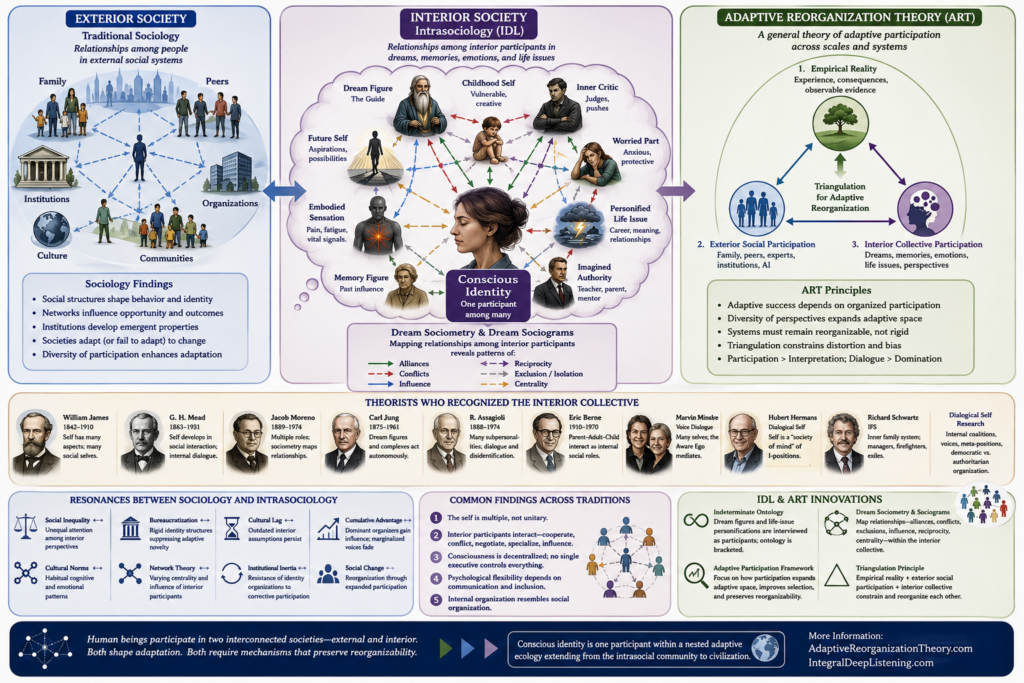
Sociology transformed the modern understanding of human behavior by demonstrating that individuals do not exist in isolation.1 Every person develops within networks of family, culture, institutions, organizations, economies, and civilizations that profoundly shape identity, belief, opportunity, and behavior. Society is not merely the background of individual life; it is one of its primary causes.2 Much of what people assume to be personal preference or private choice reflects larger patterns of social organization operating through them. This insight remains one of sociology’s greatest achievements. Yet it also points toward an overlooked question. If external social systems organize behavior so powerfully, what organizes the equally complex societies that exist within consciousness itself?
Adaptive Reorganization Theory proposes that every human being participates simultaneously in two social worlds.3 One consists of relationships among externally existing people. Sociology studies this domain. The other consists of relationships among the many organized centers of experience that populate interior life. This second domain has received attention from psychology, psychoanalysis, cognitive science, and contemplative traditions, but it has rarely been understood as a genuine social system. The systematic study of this interior social organization may therefore be called intrasociology.4 The term deliberately parallels sociology. Sociology studies societies among persons. Intrasociology studies societies within persons. Both investigate organization, communication, conflict, cooperation, hierarchy, adaptation, and change. The difference lies not in the principles being examined but in where those principles operate.
Is Consciousness Fundamentally Individual?
Most people think of consciousness as fundamentally individual.5 They experience themselves as a single self that occasionally imagines memories, fantasies, dreams, or conflicting desires. From this perspective, dreams, inner dialogue, remembered conversations, imagined futures, and symbolic figures appear to be private psychological events rather than participants within an organized society.
Intrasociology proposes a different starting assumption. Interior life is not merely a collection of isolated mental events. It is populated by relatively autonomous organizations that interact with one another in recognizable social patterns. Memories influence present decisions. Anticipated future selves negotiate with current priorities. Internalized parents continue to exercise authority decades after death. Dream characters present perspectives that often differ radically from waking identity. Cultural ideals compete with biological impulses. Professional identities conflict with family obligations. Moral commitments struggle with personal desires. Even the voice that claims to be “I” functions as only one participant within a larger interior society.6
Indeterminate Ontology
This does not require assuming that these interior organizations possess independent metaphysical existence. Adaptive Reorganization Theory deliberately suspends such ontological claims.7 Whether dream characters represent unconscious neural organizations, symbolic constructions, autonomous psychic agencies, spiritual realities, predictive models, or something else entirely remains an open question. Intrasociology studies how these organizations function within experience rather than what they ultimately are.8
This methodological suspension resembles sociology’s own approach. Sociologists need not resolve philosophical debates about free will before studying families or governments. They investigate observable patterns of interaction. Likewise, intrasociology investigates observable patterns among interior organizations regardless of their ultimate ontological status.
Historical Recognition of Interior Multiplicity
Many psychological theories have recognized multiplicity within the psyche.9 Freud described conflicts among id, ego, and superego. Jung explored complexes and autonomous archetypal dynamics. Internal Family Systems identifies protective and exiled parts. Ego-state therapy studies relatively organized personality states. Contemporary neuroscience increasingly portrays cognition as distributed across multiple competing and cooperating neural systems.10 These contributions have greatly expanded understanding of interior complexity.
Questions Asked by Intrasociology
Intrasociology differs from these approaches not because it rejects them but because it shifts the primary unit of analysis. Instead of asking how individual psychological mechanisms function, it asks how interior organizations relate to one another socially.11 Questions that sociology asks of external societies become equally meaningful within consciousness. Which organizations possess authority? Which are marginalized or silenced? Which communicate effectively? Which cooperate? Which dominate? Which preserve adaptive diversity? Which suppress dissent? How are innovations introduced? Under what conditions does rigidity emerge? What allows adaptive reorganization?
The parallels become surprisingly precise. Interior organizations develop traditions. They form coalitions. They compete for influence. They negotiate. They resist change. Some become institutionalized while others remain excluded. Successful organizations frequently become increasingly difficult to reorganize, just as successful corporations, governments, and scientific paradigms often resist adaptation despite changing environments.
Macrocosmic and Microcosmic Congruence
These similarities suggest that many principles governing social organization may operate across both external and internal domains.12 Hierarchy, cooperation, specialization, role differentiation, communication networks, conflict resolution, legitimacy, and institutional inertia all appear within consciousness as well as within society. Intrasociology therefore extends sociology’s central insight rather than replacing it. Organization itself becomes the common subject.
Intrasocial Adaptive Reorganization
Adaptive Reorganization Theory places particular emphasis on adaptive participation. Healthy societies maintain channels through which diverse participants can contribute corrective information.13 Rigid societies gradually suppress such participation, becoming increasingly vulnerable to unexpected change. The same principle appears to operate within interior life. Individuals whose identities become excessively centralized often lose contact with neglected perspectives that could reorganize maladaptive patterns. The result is psychological precipitation: successful organization becoming progressively incapable of adaptive revision.14
Intrasocial Implications for Mental Health
From this perspective, many psychological difficulties may reflect problems of interior social organization rather than isolated pathology.15 Anxiety, rigidity, repetitive conflict, defensive certainty, and chronic interpersonal difficulties may emerge because important interior organizations have become excluded, silenced, or unable to participate effectively in adaptive decision-making. Likewise, creativity, resilience, wisdom, and innovation often appear when previously marginalized perspectives become integrated into ongoing participation.
Dreaming as a Potent Window into Intrasociology
Dreams occupy a particularly important position within intrasociology because they dramatically reveal the existence of organized interior multiplicity.16 During dreaming, individuals routinely encounter independent centers of agency possessing distinct goals, emotions, knowledge, personalities, and viewpoints. Although conventional psychology often interprets these figures symbolically, intrasociology asks a different question: what happens if these organizations are approached as participants within an interior society whose perspectives deserve careful investigation before interpretation?
IDL as an Intrasociological Methodology
Integral Deep Listening was developed precisely to explore this possibility.17 Rather than immediately translating dream figures into symbols or aspects of waking identity, IDL interviews them directly as autonomous participants while suspending assumptions about what they represent. Whether these organizations ultimately prove symbolic, neurological, psychological, spiritual, or something else entirely remains secondary. The primary concern is whether systematic participation with them expands adaptive space and improves adaptive reorganization.
The Empirical Investigation Intrasociology
This practical orientation distinguishes intrasociology from speculative theories about consciousness. Like sociology, its value ultimately depends upon explanatory power, predictive capacity, and practical usefulness.18 Does understanding interior life as a social system improve diagnosis? Does it generate more effective interventions? Does it increase adaptive resilience? Can its predictions be tested? Can different interviewing methods be compared experimentally? These questions move the field beyond metaphor toward empirical investigation.
Macrocosmic and Microcosmic Reciprocity
Intrasociology therefore represents more than another psychological theory. It proposes an expansion of sociology’s original insight. Human beings do not merely inhabit societies; they are themselves organized societies. External civilizations and interior civilizations continually influence one another. Cultural institutions shape interior organization, while interior organization shapes the institutions individuals collectively create. Neither domain can be fully understood in isolation.
Recognizing this reciprocal relationship opens a broader understanding of adaptation itself. Adaptive systems reorganize not simply because individuals think differently but because the organizations participating in adaptive decision-making become more inclusive, more communicative, and more capable of reorganizing successful patterns when circumstances change. Whether these organizations exist within a family, a corporation, a scientific discipline, a civilization, or a single human consciousness, the underlying principles appear remarkably similar.
The Purpose and Function of Intrasociology
Intrasociology is therefore the study of interior social organization. Its purpose is not to replace psychology or sociology but to connect them by recognizing that organization operates across both external and internal worlds. Sociology asks how societies shape persons.19 Intrasociology asks how the societies within persons shape societies. Together they reveal adaptation as a fundamentally social process operating across every scale of organization.
For the application of Intrasociology in IDL, see IntegralDeepListening.Com.
Notes
1. Modern sociology emerged through the work of Émile Durkheim, Max Weber, Georg Simmel, Karl Marx, and others, who demonstrated that social organization possesses emergent properties irreducible to individual psychology. Social structures influence beliefs, identities, opportunities, and behavior independently of individual intentions. See Émile Durkheim, The Rules of Sociological Method (1895); Max Weber, Economy and Society (1922).
2. Contemporary sociology, social psychology, and network science consistently demonstrate that families, institutions, cultures, and social networks shape individual cognition and behavior. See Peter L. Berger and Thomas Luckmann, The Social Construction of Reality (1966); Nicholas A. Christakis and James H. Fowler, Connected (2009).
3. The proposal that human beings simultaneously participate in exterior and interior societies constitutes a central theoretical contribution of Adaptive Reorganization Theory. While numerous psychological schools recognize multiplicity within the psyche, ART reframes that multiplicity as a form of organized social participation rather than merely intrapsychic process.
4. “Intrasociology” is introduced here as the systematic study of interior social organization. It parallels sociology by extending the study of organization, hierarchy, communication, conflict, cooperation, and adaptation into the interior domain of consciousness.
5. The intuition that consciousness is fundamentally singular has been questioned by William James, George Herbert Mead, Daniel Dennett, Thomas Metzinger, Michael Gazzaniga, and numerous contemporary cognitive scientists. The everyday experience of being a unified self may be better understood as an adaptive construction than as an indivisible psychological entity.
6. George Herbert Mead argued that the self emerges through internalized social interaction. William James distinguished the experiencing “I” from the experienced “Me.” Contemporary neuroscience likewise increasingly portrays identity as distributed rather than unitary.
7. This suspension of ontological commitment resembles Husserl’s phenomenological epoché. Rather than determining what interior phenomena ultimately are, investigation begins by examining how they function within experience.
8. ART adopts an operational rather than metaphysical methodology. Competing explanations—neurological, symbolic, psychoanalytic, computational, spiritual, or predictive-processing—remain compatible provided they generate testable predictions regarding adaptive reorganization.
9. Freud described id, ego, and superego; Jung investigated complexes and archetypal autonomy; Berne described ego states; Watkins and Watkins elaborated ego-state therapy; Schwartz developed Internal Family Systems. Despite substantial differences, each recognizes organized multiplicity within consciousness.
10. Contemporary neuroscience increasingly describes cognition as emerging from distributed interacting networks rather than a central executive. Research on predictive processing, the Default Mode Network, salience networks, and global neuronal workspace theory all point toward distributed organization rather than a homuncular self.
11. This represents the principal methodological shift introduced by intrasociology. Traditional psychology primarily studies mechanisms within individuals. Intrasociology studies relationships among organized interior participants using concepts long employed within sociology.
12. Complexity science increasingly identifies common organizational principles operating across biological, social, technological, and ecological systems. Hierarchy, distributed control, network organization, resilience, and adaptive self-organization recur across scales. See Herbert Simon, John Holland, Stuart Kauffman, and Elinor Ostrom.
13. Organizational sociology, resilience theory, and complexity science consistently demonstrate that adaptive systems remain resilient by maintaining diverse channels of communication and corrective feedback. Systems suppressing dissent or reducing diversity generally become increasingly brittle over time.
14. Psychological precipitation is an original concept within Adaptive Reorganization Theory. It refers to successful organization becoming progressively resistant to adaptive reorganization. The concept parallels competency traps in organizational theory, paradigm rigidity in science, and institutional inertia in sociology.
15. This hypothesis reframes many forms of psychopathology as failures of adaptive participation rather than solely intrapsychic dysfunction. It therefore shifts attention from symptom elimination toward restoration of interior participation.
16. Dream research consistently demonstrates that dreams contain multiple interacting centers of agency possessing distinct goals, emotions, knowledge, and perspectives. Threat Simulation Theory, Social Simulation Theory, predictive processing, and contemporary dream phenomenology all support viewing dreams as organized social environments rather than random imagery.
17. Integral Deep Listening differs from interpretive dream methods by interviewing dream figures directly while suspending assumptions regarding their ontological status. The practical question becomes whether direct participation expands adaptive space and increases adaptive reorganization.
18. Intrasociology is intended as an empirical research program rather than merely a philosophical proposal. Its central claims generate falsifiable predictions concerning adaptive participation, creativity, resilience, dream interviewing, adaptive diagnostics, and comparative intervention outcomes.
19. Sociology demonstrated that society shapes persons. Intrasociology proposes the reciprocal principle: interior societies shape both persons and the societies they collectively create. Adaptive Reorganization Theory unifies these reciprocal processes within a common theory of adaptive organization operating across scales.