
Sociology, Intrasociology, and Adaptive Reorganization Theory
From Social Systems to Interior Societies
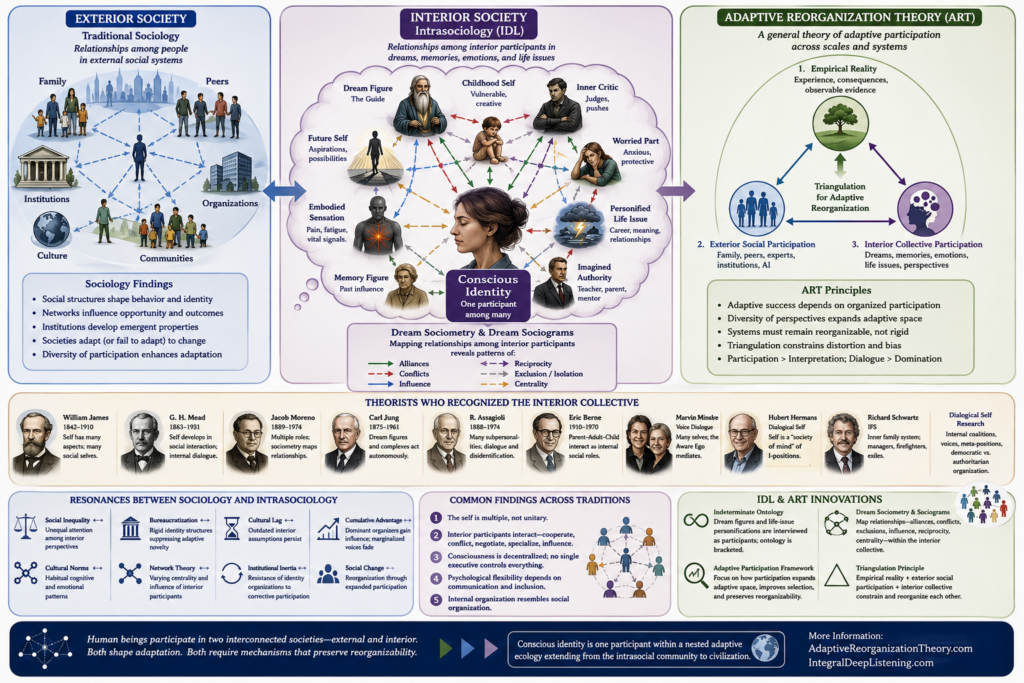
Sociology begins with a deceptively simple observation: human beings are fundamentally social creatures whose thoughts, identities, values, and behaviors emerge through participation in larger systems of relationship. Families, communities, institutions, organizations, and cultures all influence what individuals perceive, believe, and become. Throughout more than a century of research, sociology has repeatedly demonstrated that social structures shape behavior, that networks influence opportunity, that institutions develop emergent properties beyond the intentions of their members, and that societies continually struggle to adapt to changing conditions. These findings have transformed our understanding of civilization, yet sociology has generally assumed that the social world it studies consists primarily of relationships among externally existing human beings.
Integral Deep Listening (IDL) proposes that this assumption is incomplete. Human beings participate not only in social systems composed of other people but also in an interior social system populated by dream characters, remembered persons, anticipated future selves, symbolic figures, emotions, bodily symptoms, imagined authorities, transpersonal experiences, and the personifications of life issues.
Whether these participants are understood as autonomous realities, psychological constructions, cognitive simulations, or something else entirely remains deliberately unresolved within IDL’s principle of indeterminate ontology. What matters operationally is not what these interior others ultimately are but whether systematically engaging them expands adaptive participation and improves adaptive selection. This shift effectively extends sociology into what might be called intrasociology: the study of the organization, dynamics, and adaptive functions of the interior social collective.
Seen from this perspective, many of sociology’s foundational assumptions reappear at a different scale. Sociology argues that individuals cannot be understood apart from their social relationships. IDL similarly suggests that conscious identity cannot be adequately understood apart from the larger community of interior perspectives with which it continuously interacts. Just as the family socializes the child, waking identity is continually shaped by recurring patterns of relationship among dreams, memories, fantasies, fears, aspirations, bodily signals, and countless other experiential participants. Conscious identity is less an isolated decision-maker than one participant within an ongoing interior society.
Theorists Regarding Interior Collectives
The proposition that “conscious identity is less an isolated decision-maker than one participant within an ongoing interior society” has a surprisingly long intellectual history. While these thinkers differ substantially in metaphysics, methodology, and therapeutic application, they converge on one central finding: the mind is fundamentally multiple rather than singular. Where they differ is in what constitutes that multiplicity, how its members relate to one another, and whether the multiplicity is primarily pathological, developmental, computational, dialogical, or adaptive.
William James (1842–1910)
Perhaps the first modern psychologist to reject the idea of a single, unified self. James distinguished between the “I” (the knower) and the “Me” (the known self), arguing that the self consists of many partially independent aspects rather than one indivisible entity. He described multiple social selves: “A man has as many social selves as there are individuals who recognize him.” The self changes depending on context, relationships, and goals.
James introduced multiplicity but still retained a central “I” capable of moving among identities. ART would ask whether that central organizer itself may simply be another participant within a larger adaptive organization.
George Herbert Mead (1863–1931), founder of symbolic interactionism.
For Mead, the self develops through social interaction. Internal conversation mirrors external conversation. The “generalized other” becomes internalized. Thinking itself is internalized social dialogue. Mead effectively internalized sociology. IDL extends this further by proposing that interior dialogue is not limited to internalized humans but includes dream participants and personified life issues.
Jacob Moreno (1889–1974), founder of psychodrama and sociometry.
For Moreno, people occupy multiple roles rather than possessing one fixed identity. Relationships among roles determine psychological functioning. Healthy systems maximize spontaneity and creativity. Sociograms reveal hidden relationship patterns.
Dream Sociometry directly extends Moreno’s sociometry into dreaming. Rather than mapping interpersonal relationships, Dream Sociograms map relationships among dream participants.
Carl Jung (1875–1961)
Dreams present relatively autonomous figures. Complexes behave as semi-independent personalities. The psyche contains organized structures that cannot simply be reduced to conscious intention.
IDL agrees that dream figures often behave autonomously but suspends judgment regarding whether they are archetypes, complexes, spirits, or constructions. The focus shifts from interpretation to interviewing.
Roberto Assagioli (1888–1974), founder of Psychosynthesis.
Human beings contain numerous subpersonalities. Psychological growth requires dialogue among them. Disidentification increases freedom.
Assagioli is a close precursor to IDL but does not recognize indeterminate ontology. ART differs by emphasizing adaptive participation rather than integration.
Eric Berne (1910–1970), creator of Transactional Analysis.
For Berne, behavior reflects interactions among Parent, Adult, and Child ego states. These function almost as internal social roles. This is one of the earliest operational models of interior social interaction.
Hal and Sidra Stone, creators of Voice Dialogue.
The personality consists of numerous selves. Healthy functioning depends upon awareness rather than suppression. The “Aware Ego” mediates among them. Voice Dialogue is similar procedurally to IDL. IDL differs by interviewing dream perspectives directly rather than identified personality parts.
Marvin Minsky (1927–2016), author of Society of Mind (1986)
Minsky’s work provides perhaps the closest conceptual parallel outside psychotherapy. The mind consists of thousands of relatively simple interacting agencies. No central executive exists. Intelligence emerges from distributed organization and complex behavior arises from cooperation and competition among specialized processes.
Minsky provides a computational version of ART’s distributed adaptive organization. He does not investigate dreams or interviewing.
Hubert Hermans, creator of Dialogical Self Theory.
Hermans’ work is probably the closest existing academic psychology. The self is a “society of mind” composed of multiple “I-positions.” These positions cooperate, negotiate, compete, dominate, and form coalitions like members of an actual society. He emphasizes that interior dialogue mirrors external social organization.
IDL shares much with Hermans, however, Hermans studies dialogical positions while IDL studies interviewable participants of indeterminate ontology. Dream Sociometry introduces explicit relationship mapping. ART introduces adaptive participation as the governing principle.
Richard Schwartz, creator of Internal Family Systems (IFS)
The psyche contains Managers, Firefighters, and Exiles organized as a family system. Each part has positive intentions. Healing occurs through respectful dialogue. Multiplicity is normal rather than pathological.
IFS provides what is perhaps the best-known contemporary therapeutic model. IDL differs because dream figures are not assumed to be “parts.” Their ontology remains open.
Dialogical Self Research
Since Hermans, numerous investigators have expanded the idea. Findings include internal coalitions, dominant voices, marginalized voices, promoter positions, meta-positions, and democratic versus authoritarian organization within the self. The self increasingly resembles a miniature society rather than a single ego.
Common Findings Across These Traditions
Despite large theoretical differences, several conclusions recur.
The self is multiple. No major modern theory views personality as completely unitary.
Internal participants interact. They cooperate, conflict, negotiate, specialize, and influence one another.
Consciousness is decentralized. No single executive appears to control everything. Even models retaining a Self or Ego increasingly describe it as coordinating rather than commanding.
Psychological flexibility depends upon communication. Pathology often involves rigid dominance, excluded voices, and repetitive interaction rather than multiplicity itself.
Internal organization resembles social organization. Researchers repeatedly employ social metaphors of society, family, dialogue, government, committee, community, and network. This convergence is striking because it has emerged independently across psychology, sociology, psychotherapy, cognitive science, and artificial intelligence.
Where ART and IDL Go Beyond These Traditions
ART and IDL agree with the broad consensus that the mind is organized as a multiplicity. Their distinctive contribution is to recast that multiplicity in explicitly sociological and adaptive terms. Instead of asking primarily, “What are these interior entities?” or “How should they be integrated?”, they ask, “How does the organization of the interior collective affect adaptive capacity?” This shifts the focus from ontology and personality structure to the dynamics of participation. Several innovations follow from this shift.
First, IDL adopts indeterminate ontology. Unlike Jung, IFS, Psychosynthesis, or Voice Dialogue, it does not require dream figures or life-issue personifications to be interpreted as archetypes, parts, roles, subpersonalities, or autonomous beings. Their ontological status is deliberately bracketed. They are treated operationally as participants whose perspectives may contribute to adaptation.
Second, IDL introduces Dream Sociometry and Dream Sociograms, extending Moreno’s sociometry into the interior domain. Rather than merely identifying multiple voices, IDL maps their relationships—alliances, conflicts, exclusions, influence, reciprocity, and centrality—creating an empirical framework for studying the organization of the interior collective itself.
Third, ART places these observations within a general theory of adaptive participation. The crucial question is not whether the mind contains many voices—many theorists already agree that it does—but whether increasing organized participation among those voices measurably expands adaptive space, improves adaptive selection, and preserves reorganizability. This makes multiplicity testable rather than merely descriptive.
Finally, ART embeds the interior society within a broader principle of triangulation. Adaptive systems receive corrective information from three interacting sources: empirical reality, exterior social participation (family, peers, experts, institutions, and increasingly AI), and the interior collective accessed through dreams and other forms of IDL interviewing.
Conscious identity is therefore neither sovereign nor merely fragmented; it is one participant within a nested adaptive ecology extending from the intrasocial community to civilization itself. This framing transforms the “society of mind” from a psychological metaphor into one expression of a general principle of adaptive organization operating across scales.
The Irreducibility of Interior Collectives
Sociology recognizes that societies possess emergent properties that cannot be reduced to the psychology of individual members. Dream life appears to display similar emergence. Individual dream figures frequently exhibit knowledge, motivations, relationships, and patterns of interaction that are not consciously designed by the dreamer. Entire dream communities may emerge, complete with alliances, conflicts, hierarchies, and cooperative behaviors. Dream interviewing often reveals that these figures possess coherent perspectives that only become apparent through sustained dialogue. The resulting organization appears less like isolated symbols awaiting interpretation than like a dynamic social ecology.
IDL’s method of interviewing multiple dream figures therefore resembles the qualitative methods employed by sociologists studying communities. Instead of assuming that the dreamer’s waking interpretation adequately represents the entire system, IDL allows each participant to speak from its own perspective. This procedure resembles ethnographic fieldwork more than symbolic decoding. Each interviewed perspective contributes additional information regarding the organization of the whole.
Developing an Interior Collective Empiricism
Dream Sociometry extends this process further by examining relationships among multiple interior participants rather than treating each figure independently. Borrowing inspiration from Jacob Moreno’s sociometry, Dream Sociometry asks which figures cooperate, which conflict, which influence one another, which remain isolated, and which occupy central positions within the interior network. These relationships can then be represented visually through Dream Sociograms, making patterns of influence that normally remain implicit more readily observable. The resulting maps often reveal recurring coalitions, excluded perspectives, dominant organizers, marginalized participants, and potential mediators in much the same way that conventional sociograms reveal patterns within classrooms, organizations, or communities.
The Expansion of Adaptive Participation
From the perspective of Adaptive Reorganization Theory (ART), this is not simply an interesting psychological exercise. It may represent one mechanism by which adaptive participation itself expands. Sociology has repeatedly demonstrated that organizations capable of incorporating diverse perspectives generally outperform those dominated by rigid hierarchies. Scientific communities advance by exposing theories to multiple investigators. Democracies function best when diverse constituencies participate in governance. Successful organizations preserve channels through which corrective information can challenge established assumptions. Across these domains, adaptive capacity depends upon preserving organized participation among differentiated centers of information.
IDL proposes that a similar principle operates within the interior collective. Waking identity often functions as an overly centralized governing authority whose assumptions dominate internal experience. Psychological geocentrism privileges the preferences, fears, and interpretations of the waking self while minimizing or ignoring alternative interior perspectives. As this centralization increases, adaptive participation contracts. Interior diversity becomes progressively less accessible. The system becomes increasingly precipitated around familiar patterns of identity and behavior.
Interviewing dream figures therefore functions as a deliberate decentralization procedure. Rather than assuming the waking self possesses privileged access to truth, IDL temporarily redistributes authority among multiple interior participants. This does not require believing that dream figures are literally autonomous beings. Their ontological status remains bracketed. Operationally, they function as alternative centers of organization capable of contributing novel information that the dominant waking identity may overlook.
The Relevance of Accessing Interior Yet Relatively Objective Others
Here ART introduces an important distinction. Adaptive participation requires access to both exterior and interior sources of corrective information. Sociology has traditionally emphasized the importance of external others—family, peers, mentors, teachers, institutions, experts, and increasingly artificial intelligence—in expanding perspective and correcting individual biases. These remain indispensable. However, they are not the only participants capable of reorganizing identity. The interior collective may supply forms of adaptive information unavailable from external authorities because it reflects patterns of experience, emotion, embodiment, imagination, and dream organization that no outside observer can fully access.
This creates a triangulation that becomes central within IDL. Exterior objective reality of a history of personal life experience provides one source of correction through empirical evidence, consequences, and observable behavior. Exterior social reality provides another through relationships with other persons and institutions. Interior participation contributes a third through systematic dialogue with the intrasocial collective. Adaptive reorganization emerges not from privileging any one of these but from allowing each to constrain and reorganize the others. External experts can correct subjective distortions. Dream perspectives can reveal adaptive possibilities that external authorities overlook. Empirical testing ultimately determines whether either contributes to improved adaptation.
Dreaming and Adaptive Reorganizability
This framework also reframes dreaming itself. Rather than viewing dreams primarily as symbolic communications, emotional regulation, memory consolidation, or threat simulation, ART suggests that dreams may preserve an interior society of differentiated adaptive participants whose continuing interaction maintains reorganizability. Dream interviewing does not create this interior society; it merely provides systematic access to it. Dream Sociometry and Dream Sociograms then make its organization increasingly visible.
Resonances Between Sociology and Intrasociology
Many classical sociological findings acquire intriguing parallels within this intrasocial framework. Social inequality resembles the unequal distribution of attention among interior perspectives. Cultural norms resemble habitual cognitive and emotional patterns that organize recurring dream interactions. Bureaucratization resembles the increasing dominance of rigid identity structures that suppress adaptive novelty. Network theory finds an analogue in the varying centrality and influence of recurring dream figures. Cultural lag resembles the persistence of outdated interior assumptions despite changing external conditions. Institutional inertia parallels the resistance of established identity organizations to corrective participation. Even cumulative advantage appears when certain interior organizers repeatedly gain influence while marginalized perspectives become progressively less accessible.
The resulting picture is one in which sociology and psychology converge without collapsing into one another. Conventional sociology investigates adaptive organization among persons. Intrasociology investigates adaptive organization among interior participants. ART provides a common explanatory framework for both by proposing that adaptive success depends upon preserving the capacity of organized systems to remain reorganizable through expanding participation. Whether the system under examination is a family, corporation, scientific discipline, civilization, or dreaming mind becomes less important than whether it continues to permit sufficiently diverse centers of organization to participate in ongoing adaptive selection.
Conclusion
If this perspective proves empirically fruitful, sociology itself may be understood as describing only one half of humanity’s adaptive ecology. Human beings do not merely belong to external societies; they also participate continuously in interior societies. Both shape adaptation. Both develop organizations, hierarchies, alliances, conflicts, and emergent properties. Both can become excessively precipitated. Both require mechanisms that preserve reorganizability. By extending sociological concepts into the interior domain while maintaining empirical testing and indeterminate ontology, IDL and ART suggest that the future study of adaptation may require a sociology of dreaming no less than a sociology of civilization.
More Information regarding ART is available at AdaptiveReorganizationTheory.Com. More information regarding IDL is available at IntegralDeepListening.Com.